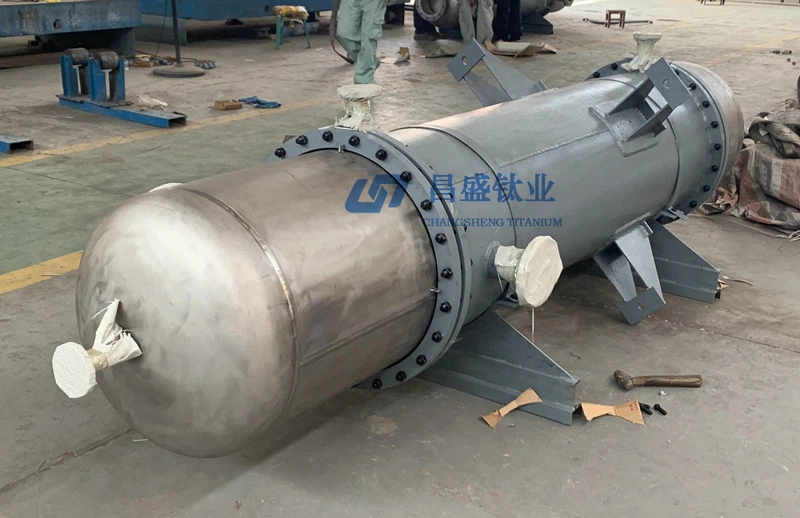
Chlor-alkali, that is, the Chlor-alkali industry also refers to the method of using saturated brine to make chlorine hydrogen caustic soda. In industry, NaOH, Cl2, and H2 are prepared by electrolysis of saturated NaCl solution, and a series of chemical products are produced by using them as raw materials, which is called the Chlor-alkali industry. Chlor-alkali industry is one of the most basic chemical industries. Its products are widely used in the light industry, textile industry, metallurgical industry, petrochemical industry, and public utilities besides the chemical industry itself.
Titanium anode electrolyzer, wet chlorine cooler, and Chlor-alkali industry
Titanium has strong corrosion resistance because it has a particularly large affinity for oxygen, and a dense oxide film will be formed on the surface to protect titanium from medium corrosion. Titanium can form a passive oxide film on the surface in most aqueous solutions. Therefore, titanium has good stability in acidic, alkaline, neutral salt solutions and oxidizing media, and its corrosion resistance is better than that of existing stainless steel and other non-ferrous metals, and even comparable to platinum.
However, if the oxide film on the titanium surface can be dissolved continuously in a certain medium, the titanium will be corroded in this medium. For example, titanium is corroded in hydrofluoric acid, concentrated or hot hydrochloric acid, sulfuric acid, and phosphoric acid because these solutions dissolve the oxide film on the titanium surface. If an oxidant or some metal ions are added to these solutions, the oxide film on the titanium surface will be protected, and the stabilization properties of titanium will increase.
Except for the above-mentioned four inorganic acids of hydrofluoric acid, concentrated or hot hydrochloric acid, sulfuric acid and phosphoric acid, and the highly corrosive aluminum chloride, titanium has good stability. Therefore, titanium is an excellent anti-corrosion material in the chemical industry and has been used more and more widely. For example, the use of titanium metal anodes and titanium wet chlorine gas coolers in the Chlor-alkali industry has achieved good economic benefits and is known as a major revolution in the Chlor-alkali industry.
The Chlor-alkali industry is an important basic raw material industry, and its production and development have a great impact on the national economy. Because titanium has better corrosion resistance to chloride ions than commonly used stainless steel and other non-ferrous metals. At present, titanium is widely used in the Chlor-alkali industry to manufacture metal anode electrolyzers, ionic membrane electrolyzers, wet chlorine coolers, refined brine preheaters, and dechlorination towers, chlorine cooling scrubbers, etc. In the past, the main parts of these types of equipment were mostly made of non-metallic materials (such as graphite, polyvinyl chloride, etc.). Due to the unsatisfactory mechanical properties, thermal stability performance and processing performance of non-metallic materials, the equipment was bulky, energy-consuming, and short-lived. , and seriously affect the quality of subsequent products and pollute the environment. Therefore, since the 1970s, the Chlor-alkali industry has successively replaced graphite electrolytic cells with metal anode electrolytic cells and ionic membrane electrolytic cells and replaced graphite coolers with titanium wet chlorine gas coolers, all of which have achieved good results.
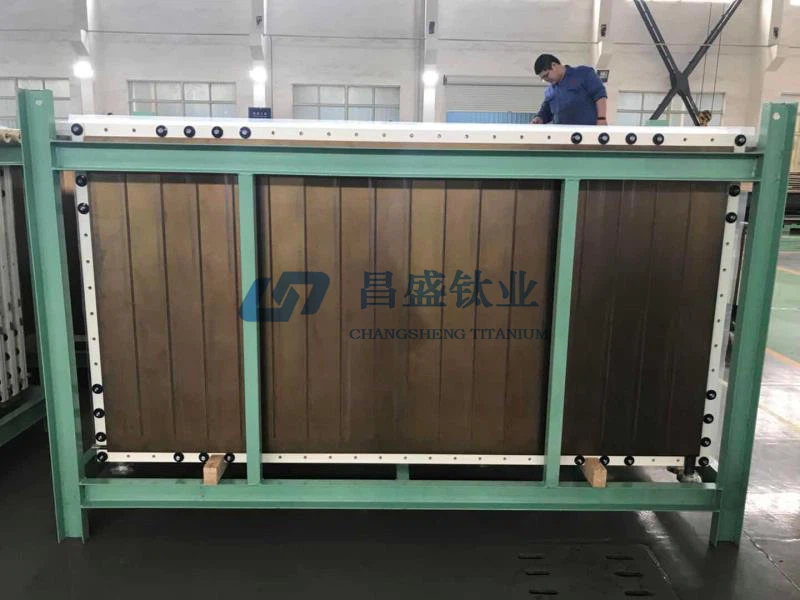
Titanium anode electrolyzer
For example, the application of titanium wet chlorine cooler, and salt electrolysis to produce Chlor-alkali will generate a large amount of high-temperature wet chlorine gas, the temperature is generally 75-95 ℃, and it needs to be cooled and dried before it can be used. The production of chlorine gas produced by electrolysis of salt has previously affected the production and quality of chlorine gas due to unreasonable cooling processes or corrosion of cooling equipment, and also seriously polluted the environment. Titanium coolers resistant to high temperature and wet chlorine corrosion were put into production, which changed the production outlook of chlorine production in the Chlor-alkali industry. Titanium is extremely corrosion-resistant in the environment of high temperature and humid chlorine gas. The corrosion rate of titanium in chlorinated water at room temperature is only 0.000565mm/a; in chlorinated water at 80 °C, the corrosion rate of titanium is 0.00431mm/a; In % wet chlorine gas, the corrosion rate of titanium at room temperature is 0.00096mm/a. After many Chlor-alkali plants have used titanium wet chlorine gas coolers, some have been used for nearly 20 years, and they are still intact.