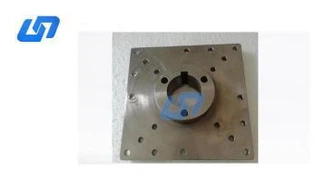
What type of metal is titanium?
Titanium is a transition metal element on the periodic table, with the atomic number 22 and symbol Ti. It is categorized as a refractory metal, meaning it has a high melting point and is resistant to heat and wear. Titanium has a unique combination of strength, low density and corrosion resistance that makes it an important structural metal.
On the periodic table, titanium belongs to Group 4 along with other transition metals including zirconium, hafnium and rhenium. It has four naturally occurring isotopes. The electronic configuration is [Ar] 4s2 3d2. Titanium has a atomic radius of 176 pm, atomic weight of 47.9 g/mol and density of 4.5 g/cm3.
It is an excellent conductor of heat and electricity, like other metallic elements. The electrical conductivity is about 2% IACS (International Annealed Copper Standard).
It has a typical silvery-grey metallic appearance when polished, although can be dark grey to black depending on surface oxidation.
Titanium is malleable and ductile, allowing it to be forged, rolled, drawn into wire and machined into various forms.
It adheres well to other metals when welded or brazed. The oxide layer may need removal prior to joining.
Titanium alloys work-harden significantly during cold deformation processing like sheet metal forming, similar to other metallic materials.
In powder form, titanium metal exhibits sinterability during powder metallurgy techniques like hot isostatic pressing.
So titanium exhibits all the characteristics of a true metallic element, albeit with some unique attributes compared to other transition metals. It occupies an important place on the periodic table between the reactive metals and noble metals.
On the Mohs hardness scale, commercially pure titanium scores around 6, which qualifies it as a hard metal. In alloyed forms, titanium can reach a hardness of over 400 HV on the Vickers scale, approaching the hardness levels of much heavier metals like steel.
Some key facts about titanium's hardness:
The hexagonal close-packed crystal structure of titanium contributes to relatively high hardness for a lightweight metal.
Alloying additions like aluminum, vanadium and molybdenum further increase hardness through solid solution and precipitation strengthening.
Work hardening effects during cold working produces a hardness spike near the surface of titanium products.
Heat treatment processes like aging can be used to selectively harden titanium alloys by manipulation of phase transformations.
On average, titanium alloys are about twice as hard as aluminum alloys but slightly softer than iron-based alloys like steels.
So while not at the top end of hardness ratings, titanium possesses sufficient hardness for structural engineering applications while still maintaining good ductility and toughness - a desirable combination.
Titanium metal is comprised solely of titanium atoms. It has an atomic weight of 47.9 amu and the atomic number 22. Some key facts about titanium metal's composition:
In its pure form, commercial titanium contains 99.5-99.9% titanium atoms by weight. Oxygen, nitrogen, carbon and iron make up the remainder.
Alloy grades contain other elements like aluminum, vanadium, molybdenum and chromium added to enhance properties.
Titanium has five naturally occurring isotopes, but only Ti-48 and Ti-50 are commercially important. Ti-48 makes up 73% while Ti-50 makes up 5.5%.
There are five allotropic crystal forms of titanium, but the hexagonal close-packed alpha phase is stable at room temperature.
During melting, pure titanium transforms from a HCP alpha structure to a higher temperature BCC beta phase at 1668°F (825°C).
Alloying elements like molybdenum, vanadium and chromium stabilize the beta phase, allowing it to exist at room temperature.
So in essence, commercially pure titanium metal consists predominantly of titanium atoms in a hexagonal arrangement. Alloy grades tailor the microstructure and properties by additions of other metallic elements.
Titanium is an exceptionally strong metal relative to its low density. On a strength-to-weight basis, titanium alloys achieve strengths comparable to medium carbon steels but are almost 50% lighter.
Some key facts about titanium's strength:
Commercially pure titanium has tensile strength levels around 63,000 psi. Alloys enhance this significantly to 160,000 psi or more.
The ultimate tensile strength of titanium alloys is higher than aluminum alloys, magnesium alloys and copper alloys.
Titanium maintains its high strength at elevated temperatures much better than other lightweight alloys like aluminum.
When used for structural parts, titanium enables greater payload capacity and fuel savings compared to heavier metallic alternatives.
The strength of titanium alloys can be tailored by heat treatment processes, allowing a materials engineer to design the optimum balance.
So titanium clearly ranks among the strongest in the class of lightweight structural metals. Its unique properties enable performance gains in critical applications like aircrafts, missiles, and power generation turbines.
References:
C. Leyens and M. Peters, eds. (2003). Titanium and Titanium Alloys. Wiley-VCH.
M. Niinomi, ed. (2008). Metals for Biomedical Devices. Woodhead Publishing.
M. Donachie Jr. (2000). Titanium: A Technical Guide. ASM International.
G. Lütjering and J. Williams (2007). Titanium. Springer Science & Business Media.
ASM Handbook, Vol 2 - Properties and Selection: Nonferrous Alloys and Special-Purpose Materials (1990). ASM International.