Anti-corrosion Application Of Titanium Materials In Power Industry
Titanium has good stability in highly corrosive hot water containing chlorides and sulfides, so it has been widely used as a cooling pipe for heat exchangers in thermal power plants. After replacing the copper-nickel alloy tube with a thin-walled titanium tube, not only the service life is greatly increased, but the overhaul time is greatly reduced, and the economic benefits are significant.
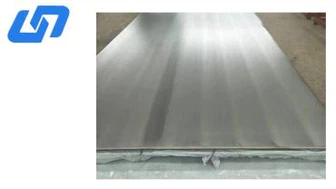
Titanium and titanium alloys have good corrosion resistance and can also be used for the anti-corrosion lining of steel chimneys. The Houshi Power Plant in Zhangzhou City, Fujian Province has adopted a seawater desulphurization system without GGH and bypass. Titanium plate is used as the anticorrosive lining of the steel chimney of the wet chimney.
Industrial pure titanium is a thermodynamically unstable metal. If Ti2+ can be produced by dissolution, the standard electrode potential for titanium ionization is -1.63 V, which makes titanium soluble in water and releases hydrogen. However, in a variety of corrosive media, titanium has very strong corrosion resistance, this is because titanium has a great passivation effect. Its passivation degree exceeds that of cobalt, nickel and stainless steel. In many active media, especially in oxidizing media, chlorine and chloride media, it has excellent corrosion resistance, but the stability of titanium in sulfuric acid and hydrochloric acid is very poor. In order to solve the problem of poor corrosion resistance of conventional titanium and titanium alloys to reducing media such as sulfuric acid and hydrochloric acid, adding molybdenum (10% 32%) to titanium alloys can greatly improve the corrosion resistance of titanium alloys to reducing media. The higher the molybdenum content, the better the corrosion resistance, but the greater the difficulty of smelting and processing. The main performance is the strengthening of the alloy, which affects the application of the alloy to a certain extent. Titanium-molybdenum alloy is more suitable for corrosion protection of steel chimneys than pure titanium. Ti-20MO and above titanium-molybdenum alloys can meet the requirements, and because of their strong chloride resistance, they are especially suitable for power plants that use seawater desulfurization. The higher the molybdenum content, the better the corrosion resistance, but the greater the difficulty of smelting and processing.The main performance is the strengthening of the alloy, which affects the application of the alloy to a certain extent. The corrosion resistance of Ti-Mo alloy is shown in Table 2. Titanium-molybdenum alloy is more suitable for corrosion protection of steel chimneys than pure titanium. Ti-20MO and above titanium-molybdenum alloys can meet the requirements, and because of their strong chloride resistance, they are especially suitable for power plants that use seawater desulfurization. The higher the molybdenum content, the better the corrosion resistance, but the greater the difficulty of smelting and processing. The main performance is the strengthening of the alloy, which affects the application of the alloy to a certain extent. The corrosion resistance of Ti-Mo alloy is shown in Table 2. Titanium-molybdenum alloy is more suitable for corrosion protection of steel chimneys than pure titanium. Ti-20MO and above titanium-molybdenum alloys can meet the requirements, and because of their strong chloride resistance, they are especially suitable for power plants that use seawater desulfurization. The corrosion resistance of Ti-Mo alloy is shown in Table 2. Titanium-molybdenum alloy is more suitable for corrosion protection of steel chimneys than pure titanium. Ti-20MO and above titanium-molybdenum alloys can meet the requirements, and because of their strong chloride resistance, they are especially suitable for power plants that use seawater desulfurization. Titanium-molybdenum alloy is more suitable for corrosion protection of steel chimneys than pure titanium. Ti-20MO and above titanium-molybdenum alloys can meet the requirements, and because of their strong chloride resistance, they are especially suitable for power plants that use seawater desulfurization.
Titanium coils are used in condensers of coastal power stations. Before the 1960s, aluminum brass tubes or B30 white brass tubes were used. With the increase of seawater pollution, the service life is greatly shortened. All-titanium condensers have been used in the UK as early as the 1960s. In the 1970s, Japan introduced thin-wall (0.3-0.5mm) welded titanium tube condensers, which greatly reduced the cost. Before 1987, titanium condensers were used in 30% of developed countries. Due to the high requirements for the safe operation and reliability of nuclear power plants, the use of titanium condensers is particularly emphasized. Most of them use thin-wall welded titanium tubes and seamless titanium tubes. China began testing domestic titanium tubes in the late 1970s. Since 1983, 18 all-titanium condensers have been used in 9 power plants, including Zhejiang Taizhou Power Plant, Shanghai Jinshan Thermal Power Plant and Zhejiang Zhenhai Power Plant. They shared 700 tons of titanium pipes. The result is satisfactory.