


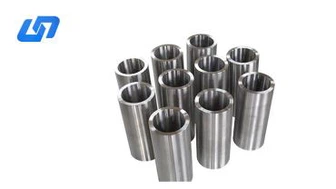
Titanium Exhaust Pipes
Product Description: Titanium Exhaust Tube
Grade: Gr1 TA1 Gr2 TA2
Size: 1.5” 2” 2.5” 3” 3.5” 4”
Diameter: 45mm 50mm 57mm 60mm 63.5mm 70mm 76mm 89mm 101.6mm
Thickness: 1.0/1.2/1.5mm Length: 3m
Product Introduction
Titanium exhaust tubing is widely used for high-performance automotive, motorcycle, racing, and motorsport exhaust systems where low weight, high-temperature capability, corrosion resistance, and reliable fabrication are important.
Compared with conventional steel exhaust tubing, titanium offers a high strength-to-weight ratio and significantly lower density. This makes it possible to reduce exhaust-system weight while maintaining the mechanical strength required for demanding applications.
Changsheng Titanium supplies titanium exhaust tubes and tubing in various diameters, wall thicknesses, lengths, and configurations, including common sizes such as 1.5", 2", 2.5", 3", 3.5", and 4", as well as customized dimensions according to drawings or application requirements.
Available materials include commercially pure titanium such as Grade 1 and Grade 2, with other titanium grades available for specific applications.
Why Use Titanium for Exhaust Systems?
Titanium is particularly suitable for performance-oriented exhaust applications because of its combination of low density, corrosion resistance, and temperature capability.
Lightweight Construction
Titanium has a density of approximately 4.5 g/cm³, considerably lower than stainless steel. Replacing conventional exhaust tubing with titanium can therefore reduce the weight of the exhaust assembly.
Weight reduction in the exhaust system can be particularly valuable in racing and performance vehicles, where reducing unsprung or rear-end weight can contribute to overall vehicle dynamics.
High-Temperature Capability
Titanium maintains useful mechanical properties at elevated temperatures and is suitable for many exhaust-system components when the alloy, wall thickness, temperature, and service environment are properly selected.
For actual exhaust-system design, the continuous operating temperature and peak gas temperature should be evaluated separately, particularly near the exhaust manifold, turbocharger, catalytic converter, or other high-temperature zones.
Corrosion Resistance
Titanium forms a stable protective oxide film that provides excellent resistance to corrosion in many environments. This makes titanium exhaust tubing resistant to rusting and suitable for applications exposed to moisture, road salts, exhaust condensate, and other corrosive conditions.
High Strength-to-Weight Ratio
Titanium combines relatively high strength with low density, allowing designers to achieve lightweight tubing without relying solely on increased wall thickness.
Custom Fabrication
Titanium exhaust tubing can be fabricated into complete exhaust assemblies using appropriate cutting, bending, forming, machining, and welding processes.
Custom configurations are available for:
Straight tubing
Mandrel-bent tubing
Sections for exhaust headers
Downpipes
Mid-pipes
Muffler connections
Collector sections
Turbocharger exhaust systems
Motorcycle exhaust systems
Custom racing exhaust assemblies
Titanium Exhaust Tube Sizes
We supply titanium exhaust tubing in standard and custom dimensions.
| Nominal Size | Typical Application |
|---|---|
| 1.5 inch | Motorcycle and compact exhaust systems |
| 2 inch | Motorcycle and automotive applications |
| 2.5 inch | Performance automotive exhaust |
| 3 inch | High-performance automotive and racing systems |
| 3.5 inch | Large-displacement and high-flow applications |
| 4 inch | High-flow, racing, turbocharged and specialty systems |
Other diameters and wall thicknesses can be manufactured according to customer drawings or specific application requirements.
Note: Nominal exhaust size refers to the intended pipe/tubing diameter. Actual outside diameter, wall thickness, and dimensional tolerances should be confirmed according to the required tubing specification.
Technical Specifications
| Property | Annealed Titanium Tubing | Spring Temper / Cold-Worked Tubing |
|---|---|---|
| Approx. Tensile Strength | 300–400 MPa | 550–850 MPa |
| Approx. Tensile Strength | 44–58 ksi | 80–123 ksi |
| Approx. Temperature Range* | -200 to +400°C | -200 to +400°C |
| Approx. Temperature Range* | -330 to +750°F | -330 to +750°F |
| Cooling / Condition | Air cooling | Air cooling |
The temperature range shown above is a general material reference and should not be interpreted as the recommended continuous operating temperature for a complete automotive exhaust system. Actual service temperature depends on titanium grade, wall thickness, exhaust-gas temperature, thermal cycling, oxidation conditions, and system design.
For exhaust applications, we can provide material and dimensional specifications according to the applicable titanium tubing standard and customer requirements.
Available Titanium Grades
Common titanium grades for tubing applications include:
| Grade | Characteristics | Typical Use |
|---|---|---|
| Titanium Grade 1 | Excellent ductility and corrosion resistance | Formed tubing, lightweight exhaust components |
| Titanium Grade 2 | Higher strength with good ductility and corrosion resistance | Automotive and motorcycle exhaust tubing |
| Grade 5 (Ti-6Al-4V) | High strength-to-weight ratio | Specialized high-performance components |
| Other Titanium Alloys | Application-specific performance | Customized engineering applications |
For many exhaust tubing applications, Grade 1 and Grade 2 are practical choices because of their formability, weldability, corrosion resistance, and availability.
Titanium Exhaust Tube Manufacturing Process
The manufacturing process depends on the required tubing dimensions, grade, surface condition, and final application.
1. Titanium Material Preparation
Titanium strip, billet, or other suitable starting material is prepared according to the required tubing specification.
2. Tube Forming
Depending on the product design, tubing may be produced through processes such as cold forming, drawing, rolling, or other controlled tube-manufacturing processes.
3. Welding
For welded tubing, the tube seam is produced using a controlled welding process suitable for titanium.
4. Cold Drawing / Sizing
Where required, additional drawing and sizing operations are used to achieve the specified outside diameter, wall thickness, dimensional tolerances, and surface finish.
5. Heat Treatment
Heat treatment may be applied when required by the material specification or product condition.
6. Cutting and Finishing
Tubing can be supplied in straight lengths or cut to customer-specified lengths. End preparation, deburring, polishing, pickling, or other finishing operations can also be provided.
Titanium Welding for Exhaust Applications
Welding is one of the most important fabrication processes for titanium exhaust systems.
Titanium and titanium alloys are highly sensitive to contamination from oxygen, nitrogen, hydrogen, and other impurities at elevated temperatures. Proper shielding is therefore essential for producing sound welds.
Key Welding Considerations
1. Effective Argon Shielding
High-purity argon shielding should adequately protect the weld pool, electrode, and heated titanium surface from atmospheric contamination.
2. Controlled Heat Input
Titanium exhaust tubing should generally be welded with controlled heat input to minimize excessive heating and distortion.
3. Back Purging
For tube welding, internal argon purging is important to protect the root side of the weld from oxidation.
4. Cleanliness
The joint area, filler wire, tooling, and surrounding work area should be properly cleaned before welding. Oil, grease, moisture, dust, and other contaminants can negatively affect weld quality.
5. Hydrogen Control
Hydrogen contamination should be minimized, particularly when welding commercially pure titanium, to reduce the risk of hydrogen-related defects.
6. Post-Weld Inspection
Depending on application requirements, welded tubing and assemblies can be inspected by visual examination, dimensional inspection, dye penetrant testing, radiographic testing, or other applicable methods.
With appropriate welding procedures and effective shielding, titanium tubing can be fabricated into reliable exhaust-system components.
Titanium Exhaust Tubing Configurations
Changsheng Titanium can supply tubing for different exhaust-system designs, including:
Straight titanium exhaust tubes
Bent titanium exhaust tubing
Mandrel-bent tubing
Titanium exhaust sections
Titanium downpipe tubing
Titanium mid-pipe tubing
Titanium collector tubing
Turbo exhaust tubing
Motorcycle exhaust tubing
Custom exhaust assemblies
Tubing can be supplied as individual components or processed according to customer drawings.
Applications
Titanium exhaust tubing is commonly used in applications where reducing system weight and maintaining reliable performance are important.
Automotive
High-performance sports cars
Supercars and hypercars
Racing vehicles
Track cars
Turbocharged vehicles
Custom performance exhaust systems
Motorcycle
Sport motorcycles
Racing motorcycles
Superbike exhaust systems
Custom motorcycle exhausts
Lightweight performance exhaust systems
Motorsport
Racing exhaust systems
Track-focused vehicles
Competition motorcycles
Performance prototypes
Weight-sensitive applications
Examples of Titanium Exhaust Applications
Titanium exhaust systems have been used in a number of high-performance automotive and motorcycle applications, including vehicles such as the McLaren P1, Porsche 911 GT3 RS, Koenigsegg Jesko, Ducati Panigale V4 R, and Yamaha YZF-R1.
In these applications, titanium is selected primarily for its low density, high strength-to-weight ratio, corrosion resistance, and suitability for high-performance exhaust-system fabrication.
The actual performance and weight benefits depend on the complete exhaust-system design, tubing dimensions, wall thickness, and vehicle configuration.
Quality Control
Each titanium exhaust tube can be inspected according to the applicable material and customer requirements.
Quality control may include:
Chemical composition verification
Mechanical property testing
Outside diameter inspection
Wall thickness inspection
Length inspection
Surface inspection
Weld inspection
Dimensional inspection
PMI where required
Dye penetrant testing where applicable
Radiographic testing for applicable welded products
Material Test Certificate (MTC)
Inspection documentation can be supplied with the shipment when required.
Custom Titanium Exhaust Tubing
Custom titanium exhaust tubing is available for OEM, motorsport, aftermarket, and engineering applications.
Customers can provide:
Outside diameter
Wall thickness
Tube length
Titanium grade
Straight or bent configuration
Bend radius
Bend angle
End configuration
Surface finish
Quantity
Drawings or 3D files
We can manufacture tubing according to customer drawings and provide additional fabrication such as cutting, bending, welding, machining, and assembly where required.
Frequently Asked Questions
What sizes of titanium exhaust tubing do you supply?
Common sizes include 1.5", 2", 2.5", 3", 3.5", and 4", with other diameters available according to drawings or application requirements.
Which titanium grade is best for exhaust tubing?
Grade 1 and Grade 2 commercially pure titanium are commonly considered for exhaust tubing because of their corrosion resistance, ductility, and weldability. Grade 5 can be considered where higher strength is required.
The appropriate grade depends on the exhaust temperature, geometry, fabrication process, and design requirements.
Can titanium exhaust tubing be bent?
Yes. Titanium tubing can be bent using appropriate tooling and controlled forming procedures. Bend radius, wall thickness, tube diameter, and material condition should be considered when designing the bending process.
Can you provide welded titanium exhaust tubing?
Yes. Welded titanium tubing and fabricated exhaust sections are available. Proper shielding and internal argon purging are important for titanium welding.
Can you supply custom titanium exhaust pipes?
Yes. We can manufacture straight tubes, bent tubing, exhaust sections, and customized components according to drawings, dimensions, and application requirements.
What is the advantage of titanium exhaust tubing over stainless steel?
The primary advantages are lower density, high strength-to-weight ratio, corrosion resistance, and good high-temperature capability. Titanium can provide significant weight savings where the design is optimized for the material.
Hot Tags:
You Might Also Like



Send Inquiry
