Application of titanium in the chemical industry: chlor-alkali
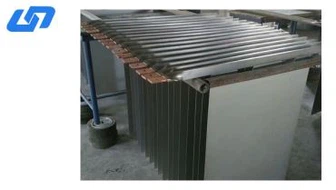
The chlor-alkali industry is a chemical industry that produces chlorine and caustic soda by electrolyzing brine solutions. It has a history of more than 100 years and is also the earliest industry in the chemical industry to use titanium. The titanium equipment used in chlor-alkali production mainly includes: metal anode electrolyzer, ion membrane electrolyzer, tubular wet chlorine cooler, refined brine preheater, dechlorination tower, chlor-alkali cooling and washing tower, vacuum dechlorination pumps and valves and other titanium equipment.
(1) Metal anodes
Chlor-alkali production processes include mercury electrolysis, diaphragm electrolysis and ion membrane electrolysis. In the past, graphite anodes have always been used in chlor-alkali anodes. In 1956, Dutchman Henry Beer first proposed the use of metal anodes, also known as dimensionally stable anodes (DSA) in electrolytic cells, and obtained patents in 1965. Dimensionally stable anodes are electrodes coated with platinum group precious metal oxides on titanium substrates. In 1968, DeNore, an Italian company, first realized the industrialization of titanium anodes in the chlor-alkali industry. Around 1970, the United States, Italy, Japan, Germany, France and other countries quickly switched to metal anodes instead of graphite anodes. In Japan, several thousand tons of titanium materials have been used as the base material of metal anodes. The production of 10,000 tons of caustic soda requires about 5 tons of titanium materials.
With the development of my country's chlor-alkali industry, the main equipment (electrolyzer) for caustic soda production has undergone three major changes. The first change was the replacement of horizontal tanks with vertical tanks. In the early 1960s, the use of (vertical adsorption diaphragm electrolyzer) replaced the traditional horizontal tanks, which greatly increased my country's caustic soda production, from 193,000 tons in 1957 to 693,000 tons in 1966, an increase of 3.6 times.
The second change was the replacement of graphite anode electrolytic cells with metal anode electrolytic cells. In the 1970s, metal anodes (DSA) were used to replace graphite anodes. my country began to test titanium anodes in Shanghai Tianyuan Chemical Plant and Tianjin Chemical Plant in 1972, and began to test 20m3 metal anode diaphragm electrolytic cells in 1973. Since 1974, 30m3 metal anode electrolytic cells have been gradually used. In 1978, the country carried out the task of metal anode technology transformation of 400,000 tons of diaphragm caustic soda. As of 1981, there were 17 chlor-alkali plants in the country using a total of 1,217 metal anode electrolytic cells, forming a diaphragm metal anode annual production capacity of 670,000 tons of caustic soda, accounting for 30% of the country's caustic soda production capacity, and 95,000 tons of mercury electrolysis capacity using DSA. As of 1996, there were 99 chlor-alkali plants in the country with a total of 8,409 metal anode diaphragm electrolytic cells, with an annual production capacity of 4.2 million tons of caustic soda, accounting for 70% of the country's caustic soda production capacity. Except for a few large chemical plants such as Tianyuan, Tianhua, Dagu Chemical, etc., which manufacture metal anode electrolytic cells themselves, most of them are manufactured and supplied by professional factories such as Beijing Chemical Machinery Plant and Shanghai 4805 Factory.
The third change was the use of ion membrane electrolyzers. In the mid-1980s, the energy-saving and efficient ion membrane method was promoted to produce caustic soda. my country introduced ion membrane caustic soda technology and equipment from Japan and other countries, forming a series of 10,000 to 50,000 tons of equipment. The main equipment includes ion membrane electrolyzers, titanium anode liquid circulation tanks, desalinated water tanks, vacuum dechlorination towers, heat exchangers, pipes and pumps, etc. Titanium equipment and titanium tubes are mainly used in anode liquid circulation systems, desalinated water systems, dechlorination systems, wet chlorine gas delivery systems and chlorine water circulation systems. Titanium pumps are mainly used to transport refined brine, anode circulating liquid, desalinated water and chlorine water. A set of 10,000-ton-level equipment uses about 8 tons of titanium. In June 1986, Yanguoxia Chemical Plant introduced Japan's Asahi Glass technology for the first time, with an annual production of 10,000 tons of caustic soda equipment. Except for the three-dimensional electrolyzer and anode liquid titanium pump supplied by Japan, the other 6 titanium equipment are all domestically matched and supplied by Jinxi Chemical Machinery Plant. By 1990, 11 chlor-alkali plants had adopted ion membrane caustic soda equipment, with a production capacity of 295,000 tons. In 1995, there were 27 chlor-alkali plants in China adopting ion membrane caustic soda equipment, with a production capacity of 827,000 tons. In 2000, the annual caustic soda production capacity of my country's chlor-alkali industry was 7.5 million tons, 14.71 million tons in 2005, and 23.99 million tons in 2010.
In the ion membrane electrolyzer, the temperature of the cathode and anode chambers is about 90°C, there is chlorine and salt solution in the anode chamber, and there is 30%~35% caustic soda solution in the cathode chamber. The general operating current density of the ion membrane electrolyzer is 30~40A/dm?. Under such harsh working conditions, the material use and anti-corrosion structure of the electrolyzer must be fully considered when designing the electrolyzer. For the anode part of the ion membrane electrolyzer (referring to the anode and the part in contact with the anode liquid), all countries in the world have chosen titanium metal (or corrosion-resistant titanium alloy) with good corrosion resistance in the anode liquid without exception.
The following is a schematic diagram of an ion exchange membrane for caustic soda. As shown in the figure, two electrodes are separated by an ion exchange membrane. Salt water is added from one side and pure water is added from the other side. After the current passes through, chlorine is produced from the anode side and hydrogen is produced from the cathode side. The ion membrane only allows sodium ions to pass, so sodium hydroxide is produced from the cathode side.
In addition to the main equipment electrolytic cell of the ion membrane caustic soda plant, the main parts where titanium equipment is used are: brine system - liquid level gauge; anode liquid system - anode liquid tank and chlorine scrubber; dechlorination tower, dechlorination brine distributor, instrument cooler; sodium hypochlorite system - cooling, absorption tower, distributor; chlorine system - wet chlorine cooler; and pest control system - heat exchanger and pest control fan.
(2) Wet chlorine cooler
When electrolyzing salt to produce caustic soda, a large amount of hot wet chlorine is generated, which can only be used after cooling and drying. There are two ways to cool hot wet chlorine: direct water spraying and indirect cooling using a tube cooler. Direct cooling not only produces a large amount of chlorine-containing chlorine water, which seriously pollutes the environment, but also causes large chlorine losses, high sulfuric acid consumption, and poor workshop working conditions. Indirect coolers are made of graphite coolers, glass tube coolers, ceramic coolers, plastic coolers, etc., but they all have many problems such as poor corrosion resistance, easy to break, and easy to age. Stainless steel indirect coolers can only be used for 8 to 10 days before they need to be stopped for repair. Test results show that titanium is extremely corrosion-resistant in a high-temperature wet chlorine environment, with an annual corrosion volume of 0.0025 mm. The use of titanium coolers in chlor-alkali industrial production can shorten the cooling and drying process, reduce chlorine losses, reduce environmental pollution, and create conditions for stable operation of compressed gas and high dryness.
In 1963, Russia began to use titanium chlorine coolers with a heat exchange area of 140sqm. It also used titanium pipelines for conveying wet chlorine, with a diameter of 300~600mm and a length of more than 500m. Almost all wet chlorine coolers used in Russia's chlor-alkali industry are made of titanium. Allied Chemical Company in the United States uses titanium instead of graphite to make coolers in the chlor-alkali industry. The original graphite tubes were scrapped after 2~3 years of use. A 78 sqm titanium cooler can complete the cooling capacity, while a graphite cooler requires 140 sqm.
The first titanium cooler in my country was manufactured by Jinxi Chemical Machinery Factory in 1965. It had a small heat transfer area of only 16.8 sqm. Since 1973, chlor-alkali plants in Shanghai, Tianjin, Beijing, Liaoning, Guangdong and other provinces and cities have successively used titanium shell-and-tube coolers with good results. There are currently hundreds of titanium shell-and-tube coolers in my country.
(3) Pumps and Valves
In the production of chlorine by membrane electrolysis and mercury electrolysis, the titanium pumps used in potassium hypochlorite and sodium hypochlorite are the most economical. Georgia-Phifek Company in the United States uses titanium pumps to pump 85°C salt solution containing 270~320g/L NaCl, NaCl crystals and more than 0.5g/L free chlorine. The service life of the titanium pump is up to 10 years.
Beijing Chemical Plant No. 2 uses cast titanium 6BA-12 pumps, Dg100Dg stop valves and titanium impellers of HTB-701l water ring ceramic vacuum pumps in the new vacuum dechlorination process. These titanium pumps and impellers have a long service life.