High Quality Coated DSA Titanium Anodes
What's the DSA titanium anodes?
DSA means Dimensionally Stable Anode, also known as DSE (Dimensionally Stable Electrode), PMTA (Precious Metal-Coated Titanium Anode), OCTA (Oxide Coated Titanium Anode), ATA (Activated Titanium Anode) or NMCA (Noble Metal Coated Anode), etc., DSA Titanium anode is a new type of high-efficiency electrode material developed in the late 1960s. It uses titanium as the substrate, because titanium is a so-called "valve" metal, it is conductive when used as a cathode in salt water, and immediately non-conductive when used as an anode, the meaning of "valve" lies in this. Titanium has the properties of a single-phase interceptor. This is due to the formation of a passivation film on its surface, which cannot be used as an anode in salt water. If coated with an enamel-electrocatalytic-semiconductive coating, it becomes a corrosion-resistant, well-conducting anode. Therefore, the titanium anode uses titanium as the base material, usually is Gr1 or gr2 material, the surface is coated with precious metal oxides, and the enamel-electrocatalysis of the surface precious metal oxides is used to work to improve electrolysis efficiency, increase current density, and corrosion resistance. Long life, no pollution, the base material can be used repeatedly, which has special advantages.
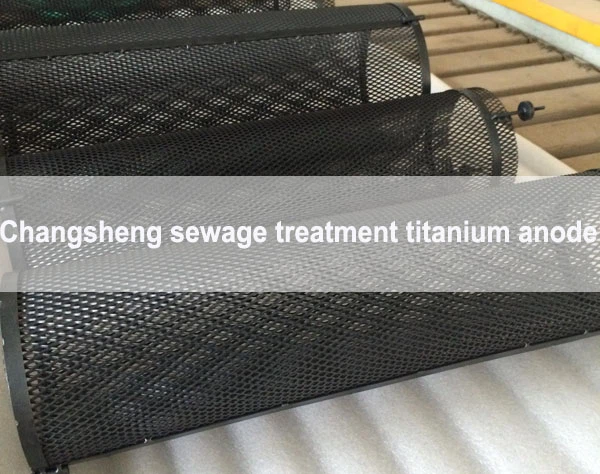
Titanium anodes can be made into plate type, mesh type, tube type, wire type, rod type, ring type, special-shaped parts, etc.
Classification of titanium anodes:
1. DSA Titanium anodes can be divided into the following fields according to their usage:
Electrolyzed water (household disinfection machine, ion water machine, household vegetable washing machine, swimming pool water disinfection, etc.).
Sewage treatment (industrial wastewater, sewage, domestic sewage treatment, COD sewage degradation, oily benzene, oilfield sewage treatment, etc.). Electrolytic metal. (sodium hypochlorite generator anode)
Electrowinning non-ferrous metals (copper, nickel, cobalt, etc.).
Plating auxiliary anodes (gold, rhodium, nickel, chromium, etc.).
Titanium anode plates for copper foil production and aluminum foil production.
Copper recovery from etching solution (direct recovery and extraction recovery).
Anodes for chlor-alkali plants.
MMO titanium anodes for cathodic protection of bridges, ship hulls, oil pipelines, etc.
2. DSA Titanium anodes are classified into oxygen-evolving anodes and chlorine-evolving anodes according to the classification of anode-emitted gases:
In the electrochemical reaction, the anode releases gas to distinguish, and the chlorine anode that releases chlorine gas, such as a ruthenium-based coated titanium electrode:
Oxidation is called an oxygen evolution anode, such as iridium-based coated titanium electrodes and platinum coatings.
Chlorine analysis anode (RuO2+IrO2+X coated titanium electrode): high chloride ion content in the electrolyte: generally in hydrochloric acid environment and electrolytic seawater, electrolytic saline environment.
Oxygen evolution anode (IrO2+Ta2O5+X coated titanium electrode): The electrolyte is generally a sulfuric acid environment.
Platinum coated anode: Gr1 or Gr2 Titanium is the base material. The surface is coated with precious metal platinum, and the thickness of the coating is generally 0.5-5um (micrometer). Platinized titanium mesh, mesh diamond size is generally 12.7 × 4.5mm or 6 × 3mm.