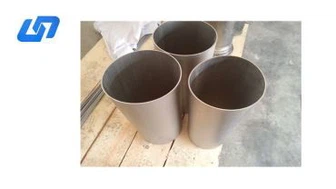
Titanium cladding material annealing features
Features of titanium cladding material annealing:
Compared with the heat treatment of other metal materials, the heat treatment of metal clad plates has many similarities. For example, they are heated to a predetermined temperature at a certain speed, maintained at this temperature for a certain time, and then cooled at a certain speed. The whole process is carried out in air or other media.
Compared with the heat treatment of other materials, the heat treatment of single cladding material also has its unique characteristics. That is, the melting point and recrystallization temperature, strength, plasticity, wear resistance and corrosion resistance, specific heat and thermal expansion coefficient, and other physical and blood-activating properties of the various members that make up the composite must be considered, especially when they are exposed to high temperatures In order to correctly design the process parameters of heat treatment and predict the influence of heat treatment on their bonding zone structure, bonding strength and their respective matrix structures and properties.
The bonding layer of titanium steel composite plate has very complex metal structure. Under special production process and heat treatment conditions, the bonding layer will produce brittle phases such as TiC, FeTi, which will directly affect the bonding strength and plasticity of the composite plate. The purpose of composite plate annealing is to eliminate the internal stress, produce recovery and recrystallization in the processed structure, and also to stabilize and homogenize the structure, eliminate harmful phases and improve the mechanical properties.
The annealing process of explosive cladding materials is formulated according to different purposes. The principle is that the components with the lowest melting point in the metal are considered in a limited way, and then the main elements constituting the metal are considered to be solid solutions or intermetallic compounds in the phase diagram, or both. It is also important to consider whether the components undergo phase transformation at high temperature, especially during high temperature annealing.
The annealing process of this kind of material is determined by experiments. The selection of its heating temperature range can be based on the following principles: the lower limit is 1/3~2/5 of the lower melting point of the composition metal, and the upper limit is 2/3~4/5 of the same melting point. For those metal combinations that do not generate intermetallic compounds on the interface, furnace stainless steel, etc., their annealing heating temperature range is very wide, especially the upper limit temperature can be very high. In general, the lower limit of the above heating temperature range may be the temperature for stress relief.
For those combinations that may form intermetallic compounds on the interface at high temperature and one of the components has phase transformation, for example, titanium cladding steel plate, a large number of tests have proved that its annealing temperature should not be too high, otherwise the combination loss will be too large and lower than the technical standard. At this time, it is contradictory to ensure a sufficiently high bonding strength.
Conclusion
1.the annealing temperature between 500~600 ℃ is ideal, which can obtain good mechanical properties and should not be too high.
2.when the temperature exceeds 900 ℃, the composite layer will undergo phase transformation, which will affect the mechanical properties.