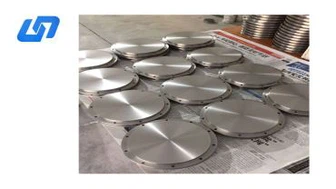
Titanium material advantages and shortcomings
Titanium material advantages and shortcomings
Titanium alloy materials have excellent properties and are widely used in aerospace and other important fields and civil fields, the promotion and application of titanium and titanium alloy materials is very important. In the same application field, stainless steel, copper alloy materials and nickel based alloy materials are also used at present. However, titanium alloy materials are excellent materials in terms of specific strength, corrosion resistance and high temperature resistance. At the same time, titanium alloy materials have absolute application advantages compared with other materials in terms of raw material price, raw material output, processing cost and titanium processing volume.
1. Excellent properties of titanium alloys
1.1 high specific strength
Comparison of density and specific strength between titanium and other metal materials
| Metal | Titanium | Steel | Aluminum | Copper |
| Density(g/cm3) | 4.5 | 7.8 | 2.7 | 8.9 |
| Specific strength(average) | 29 | 23 | 21 | 7 |
Comparison of Tensile Strength and Yield Strength between Titanium and Other Metals
| Strength | Titanium Ti-6Al4v | Stainless steel 316L | Aluminum alloy | Copper alloy |
| Tensile strength(Mpa) | 960 | 620 | 470 | 550 |
| Yield strength(Mpa) | 892 | 310 | 294 | 210 |
1.2 Excellent corrosion resistance
Seawater high-speed erosion corrosion test
Material | Corrosion rate | local corrosion depth /mm | Mark | |
| g/(m2*d) | mm/a | |||
| GR2 | 0 | - | 0 | No corrosion on the surface |
| TC4 | 0 | 0 | 0 | No corrosion on the surface |
| B30 | 0.14 | 0.005 | 0.04 | slightly corroded |
| H59 | 1.20 | 0.052 | 0.20 | slightly corroded |
| Pure copper | 19.88 | 0.811 | 0.35 | uneven corrosion |
1.3 non-magnetic
The non-magnetic property of titanium alloy material can improve the anti-magnetic interference performance of equipment, increase the concealment, and ensure that it can be applied to submarine shells and ship shells
1.4 Excellent biocompatibility and low elastic modulus
Comparison of Elastic Modulus of Titanium and Other Metal Materials
Metal | Pure titanium | Titanium alloy | stainless steel | plain carbon steel |
| Elastic Modulus/Gpa | 106.3 | 113.2 | 199.9 | 205.8 |
Compared with stainless steel and other materials, titanium alloy has low elastic modulus, excellent biocompatibility and processing formability. In recent years, it has developed into an ideal functional structural material for surgical implants. With the progress of science and technology and the deepening of clinical application, medical devices are developing towards long-life, multi-function, lightweight and low-cost, so titanium alloy is the most ideal material.
1.5 high impact and fatigue resistance
High impact and fatigue resistance can improve the equipment's ability to resist static and dynamic loads and the ability to resist the periodic impact of seawater.
2. Disadvantages and shortcomings of titanium and titanium alloy applications
2.1 poor wear resistance and low surface hardness of titanium alloy
For the parts with relative motion, the poor wear resistance and low surface hardness of titanium alloy have become the bottleneck restricting the application. Surface hardness and wear resistance can be improved by surface hardening. Such as thermal spraying, plasma nitriding, vapor deposition, salt bath nitriding and other methods. For example, using a vapor deposition method, the coating thickness reaches 2~3um, the hardness is greater than 2000hv, and the surface roughness Ra ≤ 0.8, which improves the hardness and wear resistance.
2.2 titanium alloy has good biocompatibility, and microorganisms are easy to attach
Titanium alloy materials have good biocompatibility, non-toxic and harmless, which leads to the easy attachment of microorganisms at high ambient temperature. Anti adhesion coatings (anticorrosive paint, antifouling paint, etc.) can be used. For example, the adhesion strength of the bottom layer can be increased from 5~6mpa to more than 10MPa after some anti adhesion coatings are used.
2.3 Potential difference between titanium alloy and other metals
When titanium alloy is coupled with other structural materials, the natural corrosion potential of titanium alloy in seawater is higher than that of all commonly used structural materials, so other structural materials are prone to corrosion, which is a problem to be considered in the selection of titanium alloy components in offshore structures. Insulation treatment can be adopted, such as coating insulation paint, anodic oxidation, micro arc oxidation or vapor deposition coating. For example, micro arc oxidation method can generate 10-20mm thick oxide film and improve surface resistivity.