How To Improve The Life Of Titanium Pipes?
Improving the life of titanium pipe fittings has become a major academic problem in the field of pipeline design technology.
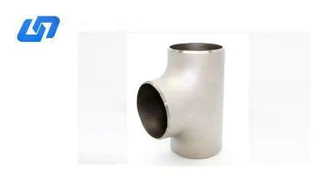
The elbow push process is a new steel elbow production technology introduced to my country by Japan in the middle and late 1980s. Because this process can achieve continuous production, and the thickness of the produced elbow is uniform, it quickly replaced the traditional process. The Northwest Nonferrous Metals Research Institute took the lead in successfully developing this new technology in the early 1990s and developed the push seamless titanium elbow. One after another, seamless titanium pipe fittings such as seamless titanium tees and seamless reducers have been developed .The maximum diameter of seamless pipe fittings can reach Φ219 and meet the requirements of ASTM B363-95 .
The processing of the push titanium elbow uses a seamless titanium tube as the blank, and the blank with a tube diameter smaller than that of the finished product is used on the special pushing extruder to push and extrude. As shown in Figure 7, the forming die is fixed on the host and there is a The active thrust pushes the billet from the right to the left. The billet is heated and protected when it is in the forming mold. The billet is expanded during the forming process. The analysis of the force during the forming process shows that the force on different parts of the billet is different. Yes, but they are compressed in two directions and pulled in one direction, that is, axial compression, radial compression, and circumferential tension. Throughout the deformation process, the diameter gradually increases, bends, and shortens in length, while the thickness is basically unchanged [4]. The experimental results of the network method confirm that the deformation of the elbow mainly occurs in the lower part. A uniform grid is drawn on the blank. During the forming, it can be observed that the square of the elbow's back is not changed greatly. The more severe the deformation of the abdomen, the grid is elongated in the circumferential direction and compressed in the axial direction, while the total area of the grid is not Change, indicating that there is no significant change in the thickness direction.