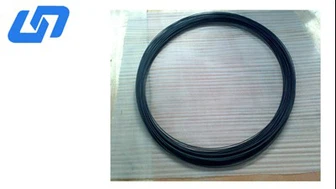
Titanium Tube Rolling Process
In the feed preheater used for pressure vessels in the purified terephthalic acid industry, due to the use environment of high temperature (280°C), high pressure (8.0MPa) and corrosive media, the pipes used in this field must have high strength, thickness and Good corrosion resistance Thick-walled Gr.3 titanium pipe is widely used in this application field.
Thick-walled titanium pipes, especially thick-walled titanium pipes with a diameter-to-thickness ratio of iDIS and ^10, are prone to surface defects, especially internal surface cracks and folds, during the cold rolling process. The mechanical properties of pure titanium largely depend on the content of interstitial elements, especially the oxygen content. The reduced oxygen content material has good plasticity and good processing performance, but this method alone does not eliminate defects such as cracks and folds on the inner surface of the pipe on a large scale, and it is difficult to ensure the strength of the pipe. Therefore, it is necessary to analyze the rolling deformation process of thick-walled pipes with different oxygen content to find out the causes of defects. For titanium, due to the influence of work hardening, there is a positive correlation between the degree of deformation and its strength and hardness. Therefore, studying the microhardness and metallographic structure on the deformed section can indirectly display different parts on the section. The size of the degree of deformation, so as to study and analyze the rolling process.
The relationship between hardness and deformation of hypoxic pipes. The hardness of each layer in the radial direction of the pipe changes continuously with the increase of e. Although there are multiple peaks on the curve, the hardness is gradually increasing. The peaks on the curves of each layer do not always appear at the same time, and the curve has Staggered, indicating that the thick-walled tube deforms unevenly in the rolling process along the radial direction; when the deformation is below 7.5%, the hardness relationship is: Out>Mid>In, check the deformation curve data, and the section outer diameter is In> Mid, the metal is at the beginning stage of wall reduction; when the deformation is 11.5%-20%, the hardness relationship is: In>Out>Mid, the hardness of the inner and outer layers of the pipe is higher than the middle layer, indicating that the wall thickness is along the radial direction at the initial stage of billeting The deformation is uneven, and the pipe is not "rolled through". Later, as the rolling progresses, as the deformation continues to increase and the tube wall becomes thinner, the unevenness of the tube wall hardness distribution in the radial direction gradually decreases.
When e exceeds 38.9% (the household is 5.61mm, and the wall reduction of the tube is 2.39mm), the hardness value of the tube wall thickness along the radial direction has little difference, indicating that the radial deformation distribution of the tube wall becomes more uniform. When the deformation is below 15.3%, the hardness of the inner and outer layers of the pipe is always higher than that of the middle layer; when the deformation is below 11.2%, the hardness relationship is: Out>Mid>In, the metal is in the reducing deformation section and the hardness curve They are consistent with each other; the uneven distribution of tube wall hardness along the radial direction gradually decreases in the late stage of milking. When e exceeds 34.8%, the hardness value of the tube wall thickness along the radial direction has little difference. When the deformation is below 7.5%, the hardness relationship is: Out>Mid>In, which is in the empty reduction stage; when the deformation is 7.5%~10%, the hardness relationship is: Out>In>Mid, the metal is decreasing The beginning of wall deformation also coincides with the hardness curve; moreover, the hardness peaks appear almost simultaneously, indicating that as the deformation progresses and the wall thickness decreases, the deformation has gradually become uniform.
The microstructures near the outer wall and near the inner wall of the low-oxygen pipe rolled in each pass. The deformed fibrous structure near the inner wall of the pipe after rolling of each pass is finer than that of the outer layer. The hardness value of the inner wall point in the hardness curve during the rolling process is greater than that of the outer wall point. Uneven deformation along the thickness direction on the cross-section during deformation.
1) From the analysis of the hardness distribution curve, the thick-walled Gr.3 titanium pipe has uneven deformation along the wall thickness during the deformation process. The increase in oxygen content will make this unevenness more complicated. In the case of a large deformation rate (35% more) and a low oxygen content, the deformation of the interrupted surface of the thick-walled tube during the rolling process will gradually become uniform. But when the oxygen content is high, even if the pipe rolling meets the condition of large de2) During the deformation of thick-walled pipes, the curve, especially the inner hole curve, should be gentle, and the feed amount should be small.