


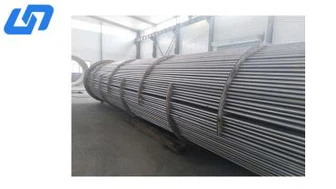
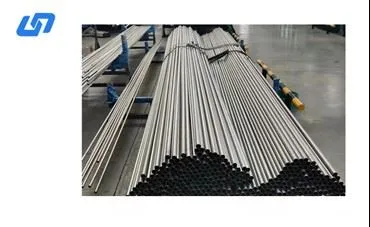
Titanium Shell and Tube Heat Exchanger
Usage:Used for evaporating, heating, condensing, cooling process
Place of Origin: China (Mainland)
Standard: ASME, MOM, DOSH, IBR, JIS, PED, GB
Warranty: 1 year
Material: titanium etc
Structure: single channel, double channel and multi-channel
Heat exchanger area: 1 - 800sqm
Working pressure: 0.3MPa~ 2.0MPa.
Product Introduction
The titanium shell and tube heat exchangers made from titanium alloys (typically Gr2 and Gr12) are a kind of equipment that transfers part of the heat from hot fluid to cold fluid. Shell and tube heat exchangers are the most widely used type of heat transfer in the chemical processing industry because of their flexibility in design and ability to handle fluids with varying levels of solids. Titanium tube heat exchangers are very special for chemical processing plants, chlorate manufacturing facilities, sulfur recovery units, hydrocarbon processing facilities, desalination processes, power generation, and many other applications, where heat exchangers shall work under acidic and/or high-temperature conditions and play an important role. It can be used as a heater, cooler, condenser, evaporator, and reboiler in chemical production.
Product Specification
Materials | Titanium Gr2/Gr12 |
Tube Sizes | 1/4″ thru 3″ |
Shell Diameter | 2″ to 144″ |
Shell Length | Up to 40 ft long |
Quality Standards | ASME Section VIII |
Industries Served | Chemical |
Titanium features
Special properties of titanium allow to use of materials and products, which are made from it, use in extreme temperatures and hostile working mediums. It is praised for high corrosion resistance, high tensile strength, and toughness. Titanium can work at 450-500 C° for a long period of time. Titanium resists corrosion to alkali, chloride, chlorinated organic substances, sulfuric acid, and nitric acid.
For shell and tube heat exchangers, the below materials are available also.
- Zirconium
- Tantalum
- Niobium
- Nickel Alloys
- Inconel
- Duplex Stainless Steel
- Stainless Steel
Explosive Bonded Materials
Process
1. The shell of the titanium shell and tube heat exchanger is usually coiled and welded with titanium plates. Welded joints shall adopt a full-penetration structure, and the minimum distance between welds shall be greater than 3 times the plate thickness and not less than 100mm. Cross welds are not permitted. Among them, lap joints, corner joints and end joints should not be used in compression conditions.
2. The type of head of titanium shell and tube heat exchanger is usually selected according to the design pressure, design temperature and service requirements of the equipment. The commonly used head types are as follows:
a) Convex head: Titanium convex head should preferably adopt elliptical head. For low pressure and normal pressure equipment, dish head and spherical head can also be used. The basic dimensions are according to JB/T4746 Regulation.
b) Conical head: Conical shells without flanges are mostly used for bottom heads of titanium equipment at atmospheric pressure, and the half-vertex angle a of the cone is ≤30°. When a > 30°, or when the joint between the cone shell and the cylinder is used as the supporting point of the equipment, the flanged cone shell should be used. The basic dimensions of the flanged conical shell are in accordance with the provisions of BT4746.
c) Flat cover: Flat covers are mostly used for atmospheric pressure titanium equipment. For upright equipment placed flat on the floor, the flat cover with folded edges can be butt-welded with the cylinder. The vertical equipment with large diameter under normal pressure can adopt T-shaped double-sided welding structure connecting the flat cover and the cylinder.
3. The flange connection of titanium shell and tube heat exchanger usually adopts loose flange connection. For equipment that may cause crevice corrosion, non-metallic or metallic materials with less wettability and swelling are usually selected. In order to prevent the loose flange from sliding or falling off, an anti-drop baffle should be provided. The number of baffles depends on the diameter of the equipment, but at least not less than 3 pieces
Hot Tags: titanium tube heat exchanger
You Might Also Like



Send Inquiry
