

Metal Anode Clssification
Soluble anode and insoluble anode
The earliest insoluble anodes were graphite and lead anodes. In the 1970s, titanium anodes began to be used in electrolysis and electroplating industries as a new technology. Currently insoluble anodes can be divided into two categories: chlorine evolution anodes and oxygen evolution anodes. Chlorine anodes are mainly used in chloride electrolyte systems. During the electroplating process, chlorine is released from the anode, so they are called chlorine anodes. Oxygen anodes are mainly used in sulfate, nitrate, and hydrocyanate electrolyte systems. Oxygen is released from the anode during the process, so it is called an oxygen evolution anode. For lead alloy anodes, they are oxygen anodes, for titanium anodes,they have the functions of oxygen evolution and chlorine evolution.
Chlor-alkali industrial use titanium anode
Compared with graphite electrodes, the diaphragm method produces caustic soda. The working voltage of graphite anodes is 8A / dm2, but coated titanium anodes can be multiplied to 17A / dm2. In this way, under the same electrolytic environment, the product can be multiplied, and the quality of the produced product is high, and the purity of chlorine gas is also high.
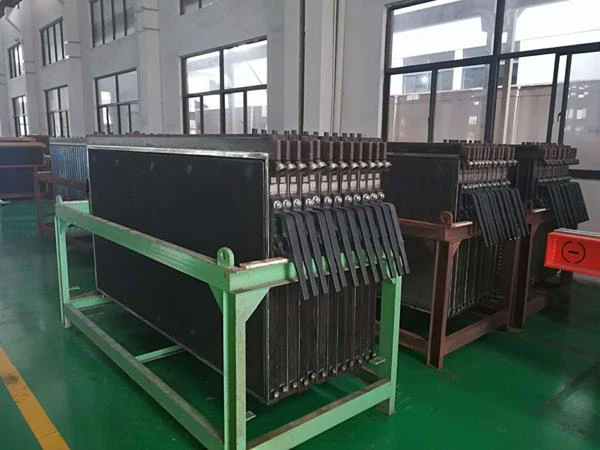
Titanium anode for electroplating
Insoluble anodes for electroplating are coated with a noble metal oxide material which has high electrochemical catalytic performance, titanium substrate including (mesh, plate, ribbon, tube, etc.). The coating contains a highly stable valve metal oxide. The new insoluble titanium anode has high electrochemical catalytic energy, and the oxygen evolution overpotential is about 0.5 V lower than that of the lead alloy insoluble anode. It has significant energy saving, high stability, does not pollute the plating solution, is light in weight, and is easy to replace. The new insoluble titanium anode has a lower oxygen evolution overpotential than the platinum-plated insoluble anode, but its life is more than doubled. Widely used as anode or auxiliary anode in various electroplating. It can replace the conventional lead-based alloy anode. Under the same conditions, it can reduce the tank voltage and save power consumption. Insoluble titanium anode has good stability in the plating process (Chemical, electrochemical), long service life. This anode is widely used in electroplating non-ferrous metals industries such as nickel plating, gold plating, chrome plating, zinc plating, and copper plating.
Lead and lead alloy anodes
The lead alloy anode is an oxygen evolution anode. The electrolyte for the oxygen evolution reaction is sulfuric acid and sulfate, which is mainly used in electrolytic metallurgy. This kind of anode has the defect that the geometric size will change during the electrolytic process. In the electrolysis process, the lead anode matrix is first converted into lead sulfate and then into lead oxide. Lead sulfate is an intermediate layer, which is an insulator and acts as a chemical barrier layer, which can protect the inner lead matrix in a sulfuric acid environment. Lead oxide is an electrode in the actual sense. The oxygen evolution reaction occurs on it. The oxygen evolution potential of lead oxide is very high, and it rises rapidly with the increase of current density. This characteristic of the lead alloy anode is oxidized by its outer layer. The inherent characteristics of lead-lead oxide is determined by the poor conductor of electricity. In addition, during the electrolysis process, the electrochemical performance of the lead oxide anode structure is continuously attenuated. The internal stresses cause the oxides to fall off layer by layer. In addition, the generation of lead peroxide also causes the oxides to continuously dissolve. Lead is converted into lead oxide again, becoming a new outer oxide electrocatalytic active material, and the inner lead matrix is oxidized to form a new lead sulfate intermediate protective layer. Therefore, during the electrolysis process, lead and its alloy elements continue to dissolve into the electrolyte and precipitate, causing solution pollution (chemical precipitation in the solution) and cathode product pollution (electrodeposition of pollutants on the cathode surface. The purity of the copper in the electrolysis cannot be very high and guaranteed).
Coated titanium anode
Coated titanium anode, commonly known as DSA (Dimensionally Stable Anode), also known as DSE (Dimensionally Stable Electrode), is a new type of insoluble anode material developed in the late 1960s. DSA coated titanium anodes are mainly used in the two major sectors of electrochemistry and electrometallurgy.
The fields of application of DSA coated titanium anodes are: chlor-alkali industry, chlorate production, hypochlorite production, perchlorate production, persulfate electrolysis, electrolytic organic synthesis, electrolytic extraction of non-ferrous metals, production of electrolytic silver catalysts, Manufacture of copper foil by electrolytic method, recovery of mercury by electrolytic oxidation, electrolysis of water, preparation of chlorine dioxide, sewage treatment in hospitals, treatment of cyanide-containing wastewater in electroplating plants, disinfection of domestic water and food utensils, treatment of cooling circulating water in power plants, wool spinning Treatment of plant dyeing and finishing wastewater, treatment of industrial water, electrolytic method to produce acid-base ion water, copper plate zinc plating, rhodium plating, palladium plating, gold plating, lead plating, electrodialysis to desalinate seawater, and electrodialysis to prepare tetramethyl hydroxide Ammonium, molten salt electrolysis, battery production, cathodic protection, anodizing for production of negative foil, aluminum foil, etc. Applications are widely involved in chemical, metallurgy, water treatment, environmental protection, electroplating, electrolytic organic synthesis and other fields.
Titanium-based lead dioxide anode
The titanium-based lead dioxide anode produced by our company is an insoluble anode,using titanium as a substrate. After the titanium substrate is acid-etched, a tin antimony oxide substrate is plated by a thermal decomposition method, and an alkaline solution is used for electroplating an intermediate layer of PbO2, then using an acidic composite plating solution to prepare a fluorine-containing β-PbO2 surface layer doped with an active metal and a particle having high adsorption pellets , thereby obtaining a new type of titanium-based lead dioxide electrode. The titanium-based lead dioxide electrode prepared by the method has low price and stable use performance, and can replace pure lead anode, lead-tin or lead-antimony alloy anode, and is used in wet metallurgy or chrome plating bath. Appearance shapes are: mesh, plate, tube, etc. The largest processing size is: 1200 * 1500mm, the surface is black. With a service life of more than three years, the titanium substrate can be used for multiple life cycles.
The main applications in the field of hydrometallurgy are: electroplated copper, electroplated nickel, electroplated cobalt, and electroplated zinc etching solution to recover copper.
Conditions of Usage:
1. Solution concentration: <30%
2. Temperature range: <80 ℃
3. Current density: <5000A/ ㎡
4. F ion content: <60mg/ l
5. Coating thickness: 0.8 ~ 3mm
6, ph value: 1 ~ 12


