


Seawater Cooling Systems fabrication equipment
anti-corrosion fabrication equipment for Seawater Cooling Systems
Material:Titanium,Titanium + carbon steel,titanium + steel
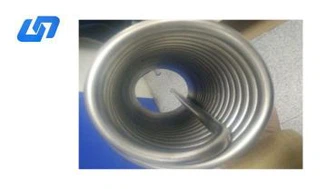
Equipment:Condenser& heat exchange tube,Water tank,Cooling Tower
we can supply fabrication as customized drawing
Product Introduction
General Introduction
The corrosion of metals in seawater is mainly electrochemical corrosion. Because in the seawater cooling process, the seawater is in full contact with the air, and the dissolved O2 in the seawater reaches a saturated state, coupled with the inhomogeneity of the metal surface and the strong conductivity of the seawater, many corrosive micro-batteries will be formed on the metal surface.
1. Corrosion protection principle of seawater cooling system
The corrosion of metals in seawater is mainly electrochemical corrosion. But not all metals will corrode in seawater, especially some metals that form a protective film on the surface. For example, titanium is not easy to corrode due to the formation of a good protective film in seawater. Therefore, it can be selected with good corrosion resistance in seawater. and choose the right metal to prevent corrosion of condenser, tube and tube sheet in the seawater cooling system, because it is the electrochemical corrosion caused by direct contact between metal and seawater, the metal surface is treated (such as coating or lining) to isolate the metal and seawater, and sacrificial anodes or ICCP are used to prevent the corrosion of the seawater cooling system; if The metal surface in the seawater is not clean, such as sediment, the metal under the sediment is prone to corrosion. Therefore, it is necessary to clean the rubber ball and sterilize the metal surface to keep the metal surface clean to prevent corrosion.
2. Corrosion protection method of seawater cooling system
According to the corrosion protection principle of the seawater cooling system, the corrosion protection method of the seawater cooling system is to select good materials. The seawater cooling condenser tube and tube sheet of the power unit are basically made of titanium, and the water delivery pipeline is made of plastic composite pipe; the second is to do a good job of coating or lining, etc. Surface treatment and cathodic protection. For the seawater circulation cooling system, the anti-corrosion of the seawater circulation cooling tower and the killing treatment of entire seawater circulation cooling system should be done well. In addition, clean the rubber ball and keep the cooling water system clean, especially the inner surface of the condenser tube.
2.1. Choose the material of the seawater cooling system
Titanium metal has high specific strength and low density. It has good comprehensive performance and excellent corrosion resistance. It is especially resistant to corrosion by seawater and polluted seawater. It has outstanding resistance to high-speed seawater erosion, which is particularly good for condensers. The ammonia corrosion in the empty pumping zone also has excellent corrosion resistance. The thin-walled titanium welded pipe has the following characteristics:
a) The surface of the pipe is smooth and bright, the welding seam inside and outside the pipe is smooth, and the transition is uniform;
b) The thickness of the pipe is uniform, the heat transfer effect is good, and the total heat transfer performance can be more than 5% higher than that of the copper pipe ;
c) Long service life. The effective operation period of a unit design is generally 30 years. The life of the titanium pipe is more than 20 years. If the maintenance is strengthened during normal operation, the unit does not need to be shut down for maintenance after installation and commissioning.
d) Low modulus of elasticity;
e) Low price.
Practice over the years has proved that titanium welded pipe has become an ideal pipe for condenser equipment in power plants along the river and coastal areas with poor cooling water quality. Although the one-time investment of the titanium tube condenser is relatively high, it is safe, reliable, long-lived, does not pollute the environment, has low operating and maintenance costs, and guarantees the quality of condensed water. Favor and attention of management personnel. At the end of 1999, the State Power Corporation officially included the domestic titanium tubes with the grades gr1 and gr2 into the "Guidelines for the Selection of Condenser Tubes for Thermal Power Plants" for the first time. Of course, the choice of corrosion-resistant materials can fundamentally solve the corrosion problem, but Generally, too much money is spent, so it is impossible to replace all the equipment with precious metal materials. Usually, it is only used in key parts, such as the tube bundle and tube sheet of the condenser is made of titanium.
2.2. Do a good job of surface treatment, coating or lining or cathodic protection.
1) Cathodic protection technology includes two methods: sacrificial anode and impressed current. Both methods have their own advantages and disadvantages. For the seawater cooling system of a power plant, the specific method to choose is often determined by factors such as the size of the required protection current, the availability of convenient input power, whether it will cause danger, and the size of the equipment structure space. Generally, for small-caliber pipelines, the seawater flow rate and medium composition change greatly, and a larger protection current needs to be provided. It is more suitable to use(ICCP) impressed current cathodic protection. In recent years, the seawater cooling system of power plants has increasingly adopted impressed current cathodic protection. Protect the surface of the condenser water tank, cooling water pipe, trash rack, steel gate, water inlet and outlet pipes of the circulating pump, and circulating water pipe with excellent protection effect.
2) Cathodic protection is an effective method to prevent or slow down the corrosion of equipment. It is generally combined with surface treatment such as coating or lining. For example, the protection of carbon steel materials often adopts a combination of cathodic protection and coating. In the cathode protection design and implementation, the selection of the protection current density and how to make the protection current evenly distributed are very important; when the cathodic protection of the equipment connected to the titanium is carried out, it is necessary to prevent the hydrogen embrittlement of titanium, that is, to control the critical potential value of hydrogen embrittlement of titanium.
2.3. Anticorrosion of seawater circulating cooling tower
The seawater circulating cooling tower mainly adopts coating anticorrosion. The coating consists of the bottom layer, the middle layer and the surface layer with matching coating film. In the anti-corrosion construction of cooling towers, the coating treatment and painting period are controlled by the atmosphere, concrete humidity, concrete leakage temperature, environment and other conditions. It is necessary to greatly maintain the overall strength of the bond between the paint and the concrete, and improve the coating's resistance to the concrete. playing a decisive role in preventing ultra-concentrated seawater, to ensure the safe operation of the cooling tower. For this reason, it is necessary to strictly control the thickness and uniformity of the coating. Wet film cards and dry film thickness gauges must continuously test the thickness and uniformity to ensure that more than 85% of the area meets the design standards, so that the anti-corrosion layer can reach the design expectations. To meet the requirements of anti-corrosion rigidity, the topcoat should be sprayed smoothly, without sagging, no pores, pinholes, no obvious spacing marks, no cracks, no peeling, and the surface is smooth, transparent and beautiful.
Table 1. The main equipment, pipeline and its materials and anti-corrosion methods in china seawater cooling system
Main equipment and pipelines of China's seawater cooling system | Material | Anti-corrosion method |
Condenser& heat exchange tube | Titanium | Choose good materials, and do a good job of cleaning the rubber balls and killing them |
Tube sheet | titanium or titanium clading steel plate | Choose good material |
Water tank | carbon steel | Coating + cathodic protection |
Seawater pipelines (straight pipes, elbows, big and small heads, etc.) | Carbon steel, cast iron | Coating + cathodic protection |
Cooling Tower | Reinforced Concrete | Corrosion and protection of seawater cooling system of generator set with anti-corrosion coating on surface |
1) The seawater cooling system is usually composed of pipelines (straight pipes, elbows, and sizes) and equipment (such as condensers, heat exchangers, filters, butterfly valves, etc.). The seawater circulation cooling system also includes a cooling tower. The material of the seawater cooling system is mainly carbon steel (such as Q235A, 10CrMoAl), stainless steel (such as 316L, 317LN), titanium (such as gr1 and gr2) and so on.
2) To comprehensively protect the seawater cooling system, the first is to select the material; secondly, to do a good job of surface treatment and cathodic protection such as coating or lining. For the sea water circulating cooling system, the anti-corrosion treatment of the sea water circulating cooling tower and the killing treatment of the entire sea water circulating cooling system must be done. In addition, cleaning the rubber ball and keeping the cooling water system clean, especially the inner surface of the condenser tube.
Hot Tags: sea water heat exchangers,cooling system marine engine,sea cooling water system,cooling seawater system
You Might Also Like




Send Inquiry
