


Material Selection And Anti-corrosion Of Seawater Desalination Equipment
Material selection and anti-corrosion of seawater desalination equipment In the desalination process, many materials are used. Commonly used shells and heat exchange materials are carbon steel, stainless steel, titanium pipe, steel pipe, and aluminum pipe. Here is a brief introduction to the corrosion of these materials in seawater. And pointed out some corresponding anti-corrosion measures.
Product Introduction
Corrosion Behavior of Metals in Seawater and Marine Atmosphere
1. Cast Iron
Type of corrosion: Graphite corrosion (iron dissolves, graphite skeleton remains).
Characteristics:
Retains shape/size but loses weight & strength.
After removing graphite + corrosion products → uneven surface corrosion.
Corrosion rate (Gray cast iron HT200 in seawater, Qingdao):
0.5 years → 0.19 mm/a
1 year → 0.16 mm/a (avg. pit 0.27 mm, max. pit 0.45 mm)
1.5 years → 0.14 mm/a
→ Rate decreases with exposure time.
Comparison with carbon steel:
Fully immersed zone: 0.18 mm/a (1 year).
Marine atmosphere: 0.06 mm/a (1 year).
High-nickel cast iron:
1.5 years: ~⅓ rate of ordinary cast iron.
Max. pit depth < 0.20 mm.
2. Stainless Steel (Marine Environment, Qingdao My Island: 36°03′N, 125°25′E, T=13.6 °C, salinity=32‰, pH=8.2)
Atmosphere exposure (8 years):
F179, Cr19Ni10, 00Cr18Mo2 (~17% Cr): no corrosion, only loss of luster.
Rate < 0.3 μm/year.
2Cr13 (low Cr): brown rust layer, full corrosion.
Rate ≈ 5 μm/year, max. pit < 0.2 mm.
Full immersion zone:
Corrosion resistance ranking:
00Cr18Mo2 > 0Cr19Ni10 > 1Cr18Ni19Ti > F179 > 2Cr13.
3. Aluminum Alloys
Advantages: High strength, low density, generally good seawater resistance.
Corrosion forms: Pitting, crevice corrosion, intergranular corrosion.
Fouling influence:
No antifouling ability → marine organisms worsen corrosion.
Oyster fouling → deep localized crevice corrosion.
Clean surfaces → lighter but denser pitting corrosion.
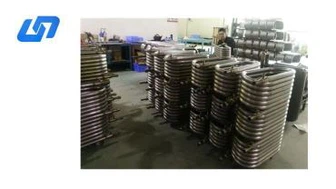
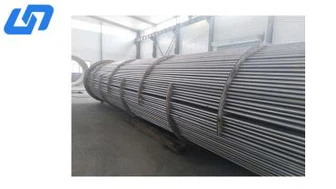
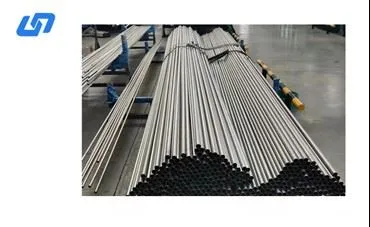
4. Titanium Tubes for Seawater Systems
Material properties:
Low density, high specific strength (≈3× stainless steel, 1.3× aluminum alloy).
Strong passivation from stable, self-healing oxide film.
Good heat transfer (benefits from thin walls + dropwise condensation).
Resistant to scaling and biofouling.
Advantages over copper alloy tubes in desalination:
Thinner walls:
Copper alloy: 0.9–1.2 mm.
Titanium: ~0.5 mm.
Heat transfer:
Titanium: 17 W/(m·K).
Aluminum brass: 100 W/(m·K).
70/30 Cu-Ni: 29 W/(m·K).
Thin-walled titanium > 70/30 Cu-Ni in performance.
Economic competitiveness:
Titanium density ≈ 50% of copper alloys.
For equal heat transfer area → titanium tube weight ≈ 25% of copper alloy tube.
Service life:
Titanium resists Br⁻ attack, sand erosion, biofouling corrosion.
Stable even under oxygen injection conditions (copper alloys fail here).
Quick Comparison Table
Material | Main Corrosion Type in Seawater | Rate / Depth (typical) | Remarks |
Cast Iron (HT200) | Graphite corrosion | 0.14–0.19 mm/a (1–1.5 yrs); max pit 0.45 mm | Rate decreases with time |
High-Ni Cast Iron | Localized corrosion (milder) | ~⅓ of ordinary CI; max pit < 0.20 mm | Better resistance |
Carbon Steel | General corrosion | 0.18 mm/a (immersion); 0.06 mm/a (atmosphere) | Similar to cast iron |
Stainless Steel (≥17% Cr) | Atmospheric → negligible; Immersion → varies | <0.3 μm/a (atmosphere); immersion resistance order: 00Cr18Mo2 > 0Cr19Ni10 > 1Cr18Ni19Ti > F179 > 2Cr13 | Mo-alloyed steels best |
Aluminum Alloys | Pitting, crevice, intergranular | Localized deep pits esp. under fouling | Lightweight but fouling-sensitive |
Titanium Tubes | Strong passivation, no pitting | Practically immune in seawater | Long life, thin-wall, best choice for desalination |
Hot Tags:
You Might Also Like


Send Inquiry
