

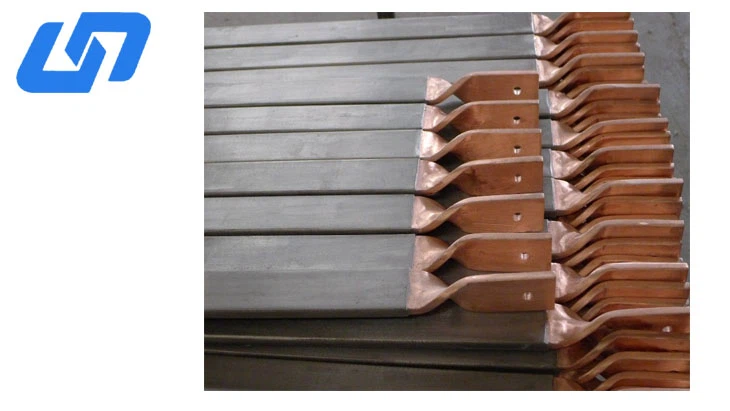


Titanium clad copper bar
Base material: copper
Cladding material: titanium
Production method: extrusion- explosion- hot rolled
Product Introduction
Titanium clad copper bar is coated with a certain thickness of titanium layer on the copper rod through a metallurgical bonding process. This titanium composite material combines the excellent electrical conductivity of copper with the corrosion resistance of titanium, making it an ideal material for use in electrolysis, electroplating, hydrometallurgy, and metal anode electrolytic cells under strong corrosion conditions.
The titanium composite rod produced by Baoji Changsheng has a composite strength of 135Mpa and a tensile and shear strength of 180-260Mpa. This strength allows for reliable and durable use in a variety of applications. Additionally, the low micro-resistance of the composite rod (7.77×10⁻⁶Ω) helps to reduce pollution in the electrolyte and electroplating solution, saving energy and improving the environment.
Specification
1. extrusion + stretching method Copper rod inserted into the titanium tube welding blank
2. extrusion + stretching method Vacuum cast molding blank
3. Explosion
4. Explosion + rolling method
The above two Titanium cladding copper bar manufacturing methods all implement the GB/T-8165-2008 national standard. This standard is not equivalent to the Japanese JISG3601-1990 standard, the main technical indicators are the same or higher than the Japanese standard
Today, regarding the cladding plate used for pressure vessels, explosive cladding and rolling cladding each has its own standards. After 2009, the explosive cladding plate was subjected to the NB/T47002-2009 standard for explosive welded cladding plates for pressure vessels. According to the different cladding layers, there were four kinds: stainless steel, nickel-based alloy and copper. YB/T4282-2012 is the standard for hot rolled cladding plate for pressure vessels. This also shows that the explosion and rolling are the same, and the production of pressure vessels is the same, and the technology and use are the same.
Titanium cladding copper anode bar are commonly used in electrolysis processes to improve efficiency and durability. The combination of high electrical conductivity from the copper core and corrosion resistance from the outer layer of titanium makes it an ideal material for use in many electrolysis applications.
Electroplating, chlor-alkali production, and electrowinning are all common applications in electrolysis. The ability to resist corrosion from the electrolyte solution is particularly important in electroplating, where the production of copper-plated objects requires a durable and long-lasting anode material.
In chlor-alkali production, the harsh chemical environment can cause rapid corrosion of the electrodes. The use of this titanium composite material can help to improve the durability of the electrodes and reduce the need for frequent replacement.
Similarly, in electrowinning, the anode material is subjected to a harsh chemical environment that can cause corrosion and degradation. The use of titanium composite rod can help to improve the durability of the anode and maintain the efficiency of the process.
Hot Tags:
You Might Also Like



Send Inquiry
