


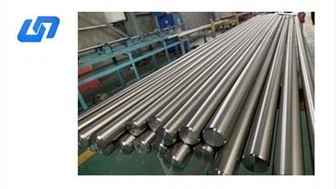
Grade 7 Titanium Bar
standard: ASTM B348
chemical composition: Ti0.12%~0.25%Pd
Excellent anti-corrosion performance.
Product Introduction
When standard titanium grades fail in aggressive chemical environments, Grade 7 titanium delivers.
Engineered with a controlled palladium (Pd) addition, Grade 7 (Ti–0.15Pd) offers exceptional resistance to both oxidizing and reducing acids, making it the preferred material for critical applications where reliability, safety, and long service life are essential.
Performs where Grade 2 cannot survive
More cost-effective than high-nickel alloys (e.g., Hastelloy)
Minimizes downtime and maintenance costs
The key advantage of Grade 7 lies in its palladium content (0.12–0.25%), which enables:
Rapid passivation in harsh chemical media
Self-healing (re-passivation) in low-oxygen conditions
Strong resistance to localized corrosion (pitting & crevice)
This makes it one of the most reliable titanium grades for acid service applications.
Where It Outperforms Other Materials
Material | Performance in Reducing Acids | Cost Level | Typical Issue |
Grade 2 Titanium | Poor | Low | Rapid corrosion in HCl |
Grade 5 Titanium | Moderate | Medium | Not designed for corrosion |
Nickel Alloys (Hastelloy) | Excellent | Very High | Expensive |
Grade 7 Titanium | Excellent | Medium | Best balance |
Conclusion: Grade 7 offers the optimal balance between performance and cost.
Typical Harsh Environments
Grade 7 titanium is specifically designed for:
Hydrochloric acid (HCl) systems
Sulfuric acid (H₂SO₄) with unstable oxygen levels
Chloride-rich and low pH environments
Wet chlorine and hypochlorite conditions
Marine and seawater exposure
Especially effective where corrosion failure is a recurring issue.
Key Industrial Applications
Chemical Processing
Pickling tanks – extends service life in acid cleaning systems
Reactors & pressure vessels – stable under aggressive chemical attack
Environmental Systems
Flue Gas Desulfurization (FGD) – resists acidic condensates and chlorides
Heat Transfer Equipment
Heat exchangers & condensers – reliable in chloride cooling water
Fluid Handling Systems
Pumps, valves & piping – reduces maintenance and leakage risks
Electrochemical Industry
Electrolyzers & centrifuges – stable under electrochemical conditions
Core Advantages
Outstanding corrosion resistance in both oxidizing and reducing acids
Proven performance in chloride and low pH environments
High strength-to-weight ratio (lightweight + durable)
Excellent weldability and fabrication flexibility
Long service life with reduced total cost of ownership
Product Specifications
Item | Specification |
Standard | ASTM B348 |
Grade | Grade 7 (Ti–0.15Pd) |
UNS | R52400 |
W.Nr. | 3.7235 |
China Grade | TA9 |
Size Range | Ø 1.0 – 400 mm |
Length | Customized |
Surface | Polished / Pickled |
Supply Condition | Annealed / Forged / Machined |
Quality & Reliability
We ensure consistent quality through:
100% Ultrasonic Testing (UT)
EN 10204 3.1 Mill Test Certification
Strict chemical composition control
Full material traceability
Hot Tags:
You Might Also Like




Send Inquiry
