

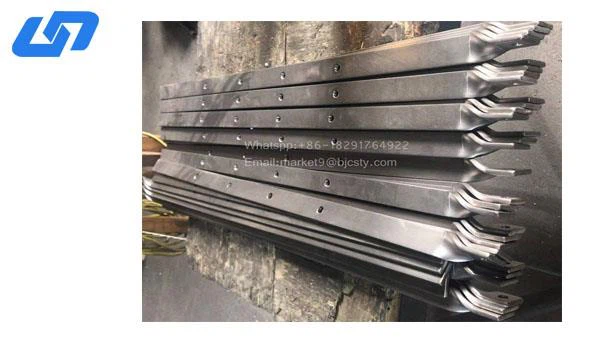


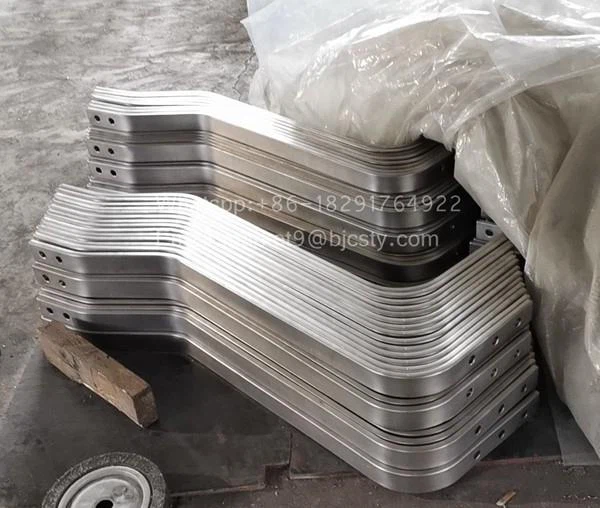
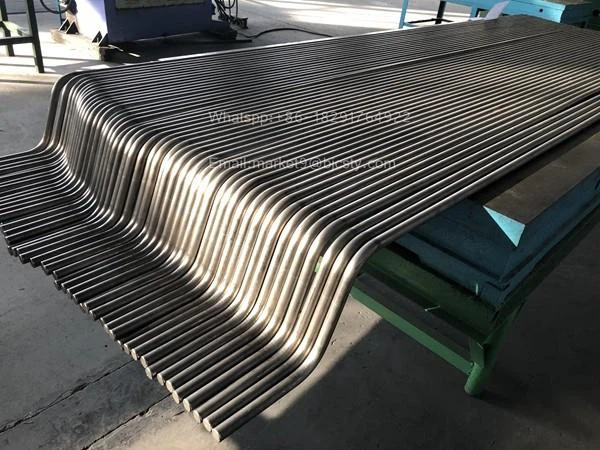

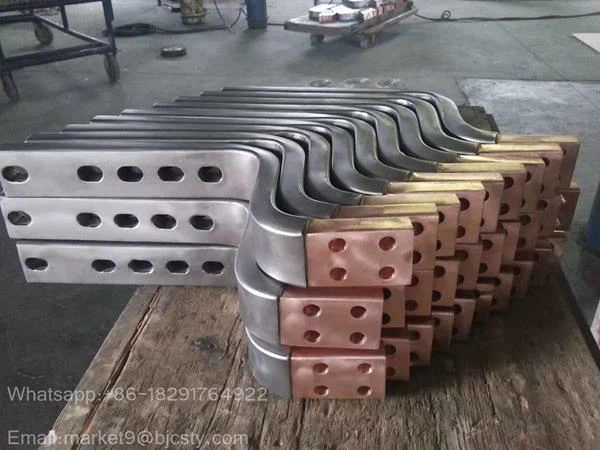
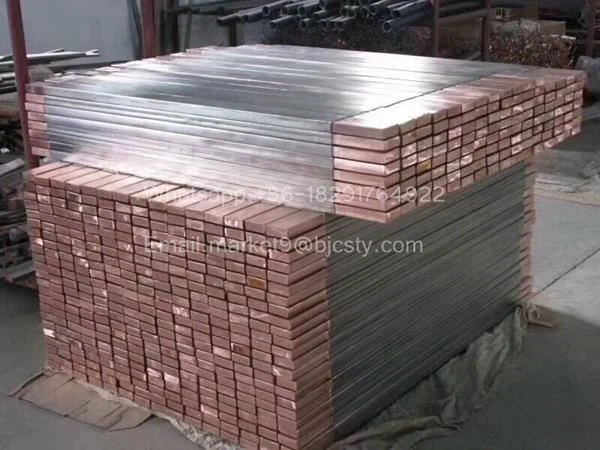
Titanium copper bar
Base materials: copper T1, T2, Al, etc.
Cladding materials: titanium, zirconium, stainless steel (304, 316l), nickel, tantalum, etc.
Traditional cladding thickness: 1.0 ~ 2.5 mm
Product Introduction
Widely used as conductive connectors for titanium anodes and mixed metal oxide (MMO) anodes, titanium clad copper bars have become essential components in chlor-alkali plants, electroplating facilities, hydrometallurgical operations, and electrochemical water treatment systems.
Product Structure
Core Material
High-conductivity copper
ASTM C11000 / C10100 copper grades available
Cladding Material
Commercially Pure Titanium Grade 1 (Gr1)
Commercially Pure Titanium Grade 2 (Gr2)
Bonding Method
Explosion Bonding
Hot Rolling Cladding
Customized composite manufacturing processes
The metallurgical bond between titanium and copper ensures excellent conductivity, mechanical strength, and long-term reliability.
Key Advantages
Excellent Electrical Conductivity
The copper core provides superior electrical conductivity, ensuring efficient current transfer and minimizing voltage loss in electrochemical systems.
Outstanding Corrosion Resistance
The titanium outer layer protects the conductor from aggressive environments, including:
Chlorine-containing electrolytes
Sodium hypochlorite solutions
Acidic media
Seawater
Industrial wastewater
Long Service Life
Compared with conventional conductive materials, titanium clad copper bars offer significantly longer operational life and reduced maintenance requirements.
High Mechanical Strength
The metallurgical bonding process creates a strong and durable interface between titanium and copper, preventing delamination during long-term operation.
Energy Efficiency
Lower electrical resistance results in:
Reduced power consumption
Improved current efficiency
Lower operating costs
Environmentally Friendly
The extended lifespan reduces replacement frequency and material waste, contributing to more sustainable industrial operations.
Typical Specifications
| Parameter | Specification |
|---|---|
| Copper Material | ASTM C11000 / C10100 |
| Titanium Material | Gr1 / Gr2 Titanium |
| Standard | GB/T 12769, ASTM Standards |
| Bonding Method | Explosion Bonding / Hot Rolling |
| Surface Finish | Machined, Pickled, Polished |
| Length | Customized |
| MOQ | Available upon request |
Manufacturing Processes
Explosion Bonding
Explosion bonding uses controlled explosive energy to create a permanent metallurgical bond between titanium and copper.
Advantages
Extremely strong bonding interface
Suitable for thick cladding layers
Applicable to various metal combinations
Excellent reliability
Characteristics
High bonding strength
No adhesive layers
Excellent conductivity
Hot Rolling Cladding
Hot rolling combines titanium and copper under elevated temperature and pressure.
Advantages
High production efficiency
Uniform bonding interface
Suitable for mass production
Excellent dimensional consistency
Characteristics
Economical for large-volume production
Consistent product quality
Applications
Chlor-Alkali Industry
Titanium clad copper bars are widely used as:
Conductive rods for titanium anodes
DSA (Dimensionally Stable Anode) conductors
Electrolyzer busbar connections
Brine electrolysis systems
Electroplating Industry
Used in:
Conductive anode bars
Plating racks
Electroplating fixtures
High-current transmission systems
Electrochemical Water Treatment
Suitable for:
MMO titanium anode conductors
Electrochlorination systems
Electro-oxidation units
Wastewater treatment equipment
Hydrometallurgy
Applied in:
Electrowinning systems
Electrorefining cells
Metal recovery systems
Copper recovery processes
Cathodic Protection Systems
Used as:
Anode conductors
Current distribution bars
Corrosion protection systems
Compared with Traditional Conductors
| Feature | Titanium Clad Copper | Conventional Materials |
|---|---|---|
| Conductivity | Excellent | Good |
| Corrosion Resistance | Excellent | Limited |
| Service Life | Very Long | Shorter |
| Maintenance Cost | Low | Higher |
| Energy Efficiency | High | Moderate |
| Mechanical Strength | High | Moderate |
Benefits for Electrochemical Systems
Titanium clad copper bars offer significant advantages in modern electrochemical operations:
Higher electrical efficiency
Lower voltage drop
Improved current distribution
Reduced maintenance downtime
Enhanced process stability
Longer equipment lifespan
Lower total operating costs
These advantages make titanium clad copper bars the preferred conductive material for modern titanium anode and MMO anode systems.
Quality Assurance
All titanium clad copper bars undergo strict quality inspections including:
Bonding strength testing
Dimensional inspection
Electrical conductivity verification
Surface quality inspection
Ultrasonic testing (available)
Material certification
Certificates available:
ISO 9001
Mill Test Certificates (MTC)
Material Traceability Documentation
Packaging & Delivery
Standard Packaging
Protective plastic wrapping
Moisture-resistant packaging
Export-grade wooden cases
Customized Packaging
Packaging solutions can be tailored according to customer requirements and transportation methods.
Hot Tags:
You Might Also Like




Send Inquiry
