

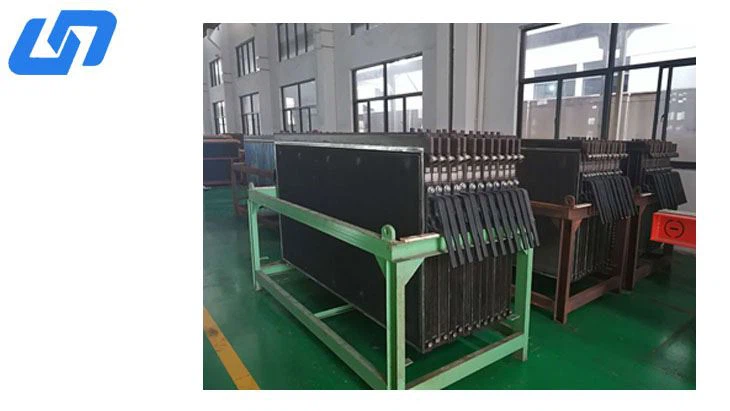
Chlor-alkali Anode and Cathode
size: 2402mmW×1285mmH×62mmT
area: 2.7m2
current density: 1.5~6.0kA/m2
unit cell voltage:≤2.96V (6.0kA/m2)
Product Introduction
Our Chlor-Alkali Anode & Cathode system is designed for zero-gap membrane electrolyzers, delivering high efficiency, low energy consumption, and stable long-term operation. Compatible with major industry designs, it can effectively replace systems from UHDE, AKC, NBZ, and CEC.
The system utilizes a titanium-based anode with advanced Ru-Ti coating and a nickel cathode, optimized for high current density and superior electrochemical performance in chlor-alkali production.
Key Features
Optimized for zero-gap electrolyzer technology
Low energy consumption and reduced cell voltage
High current density operation capability
Excellent corrosion resistance (Ti/Pd sealing surfaces)
Stable electrode geometry and long service life
Reduced leakage current and improved cell rigidity
High chlorine purity and improved product quality
Electrode Materials
Anode: Titanium substrate with Ru-Ti coating
Cathode: Nickel-based structure with advanced cathode mesh design
Sealing Surface: Titanium/Palladium (Ti/Pd)
Available Cell Sizes
2.7 m² electrolyzer
3.3 m² electrolyzer
Process Advantages
Compared to traditional graphite electrodes:
Lower chlor-alkali potential
Reduced coating consumption
Higher chlorine purity
Lower overall energy usage
Improved operational stability
Electrochemical Reaction Principle
Anode Reaction (Oxidation)
Purified brine (NaCl solution) enters the anode chamber and is subjected to direct current:
NaCl dissociates into Na⁺ and Cl⁻ ions
Cl⁻ ions are oxidized at the anode to form chlorine gas (Cl₂)
Remaining brine and chlorine gas are discharged
Cathode Reaction (Reduction)
In the cathode chamber:
Water dissociates into H⁺ and OH⁻ ions
H⁺ ions are reduced to form hydrogen gas (H₂)
OH⁻ ions combine with Na⁺ ions to produce caustic soda (NaOH)
Overall Output
Chlorine gas (Cl₂)
Hydrogen gas (H₂)
Sodium hydroxide (NaOH)
Applications
Chlor-alkali chemical plants
Caustic soda production facilities
Industrial chlorine and hydrogen generation
Electrochemical processing systems
System Advantages
Improved energy efficiency and reduced operating costs
Enhanced durability in highly corrosive environments
Reliable continuous operation under industrial conditions
Compatible with modern membrane electrolyzer technologies
Hot Tags:
You Might Also Like




Send Inquiry
