

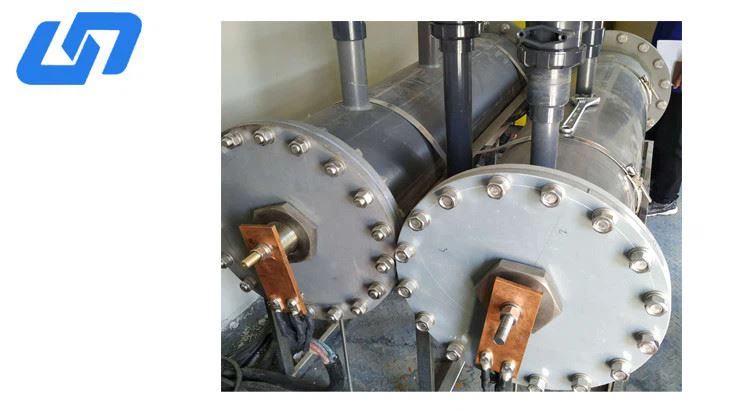
Ru Ir Coating Titanium Anode For Chlorine Generator
Application: Chlorine Generator
Product: Ru/Ir coated titanium anode
Coating: Ru/Ir oxide
Base materials: titanium Gr1 sheet/mesh
Origin: China
Product Introduction
Product Overview
Ru–Ir (Ruthenium–Iridium) coated titanium anodes are widely used in electrolytic chlorine generation systems, particularly in saltwater swimming pools, spa systems, and industrial water treatment applications.
The anode is manufactured by coating a titanium substrate with a noble metal oxide layer composed of ruthenium oxide (RuO₂) and iridium oxide (IrO₂). This coating provides excellent electrocatalytic activity for chlorine evolution, ensuring efficient electrolysis performance and long service life.
Due to their high corrosion resistance, energy efficiency, and durability, Ru–Ir coated titanium anodes are considered one of the most reliable electrode materials for chlorine generation systems.
Applications
Chlorine Generation via Electrolysis
Ru–Ir coated titanium anodes play a critical role in electrolytic chlorine generators, enabling the efficient conversion of chloride ions in saline water into chlorine gas for disinfection purposes.
Swimming Pools and Spa Systems
These anodes are commonly used in saltwater chlorination systems, providing a continuous and stable chlorine supply to maintain safe and hygienic pool water with minimal chemical additives.
Water Treatment Systems
In municipal and industrial water treatment facilities, Ru–Ir coated titanium anodes are used for:
Water disinfection
Oxidation processes
Electrochemical treatment systems
Key Advantages
Excellent Corrosion Resistance
Titanium substrates already offer excellent corrosion resistance, and the Ru–Ir oxide coating further enhances durability in aggressive electrolytes containing chlorides.
Long Service Life
The noble metal oxide coating significantly extends the electrode lifetime, reducing maintenance frequency and replacement costs.
High Energy Efficiency
The Ru–Ir coating reduces the chlorine evolution overpotential, allowing electrolysis to operate at lower voltage and reduced power consumption.
Low Maintenance
These anodes resist scaling, fouling, and degradation, minimizing cleaning requirements and reducing system downtime.
Stable Electrochemical Performance
The coating ensures uniform current distribution and stable chlorine production, maintaining consistent system performance over time.
Technical Specifications
Capacity | Voltage (DC) | Current (DC) | Salinity | Interface | Connecting Pillar | Pressure Vessel | Tank Material |
50 g/h | ≤5 V | ≤60 A ±20% | 2%–5% | G1" | M8 × 40 mm | ≤0.2 MPa | Acrylic / PVC |
100 g/h | ≤5 V | ≤125 A ±20% | 2%–5% | G1/2" | M16 × 40 mm | ≤0.2 MPa | Acrylic / PVC |
300 g/h | ≤20 V ±5 V | ≤84 A ±20% | 2%–5% | G1/2" | M12 × 30 mm | ≤0.2 MPa | Acrylic / PVC |
500 g/h | ≤30 V | ≤120 A ±20% | 2%–5% | G1/2" | M22 × 30 mm | ≤0.2 MPa | Acrylic / PVC |
1000 g/h | ≤40 V | ≤156 A ±20% | 2%–5% | G3/4" | M27 × 50 mm | ≤0.2 MPa | Acrylic / PVC |
Important Notes
The actual current and voltage values may vary depending on the salinity and concentration of the electrolyte solution.
Electrolyzers can be customized in different configurations, including:
Plate type
Tubular type
Other customized designs
Advantages Compared with Traditional Anodes
Compared with graphite or lead anodes, Ru–Ir coated titanium anodes offer several advantages:
Stable electrode dimensions, maintaining consistent electrode spacing during electrolysis
Lower operating voltage, reducing energy consumption by approximately 20%
Longer service life, with strong resistance to chlorine and alkali corrosion
Higher allowable current density, improving production efficiency
Improved product purity, preventing contamination of electrolyte or cathode products
Higher current efficiency, avoiding deformation and short circuits common with lead anodes
Reusable titanium substrate, reducing long-term material costs
For example, in chlor-alkali production using the diaphragm process:
Graphite electrode current density: ~8 A/dm²
Titanium MMO anode current density: ~17 A/dm²
This allows significantly higher production capacity within the same electrolytic cell.
Chlorine Generation Principle
In the electrolysis process:
Chloride ions (Cl⁻) from the saline solution are oxidized at the anode.
Chlorine gas (Cl₂) is generated at the anode surface.
The Ru–Ir oxide coating acts as an efficient catalyst, accelerating the chlorine evolution reaction while maintaining electrode stability.
This ensures high chlorine production efficiency and long-term operational reliability.
Hot Tags:
You Might Also Like



Send Inquiry
