


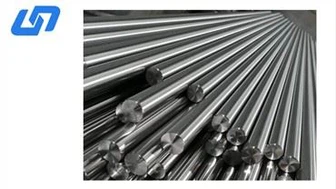
Titanium Bar Metal
Composition: Ti-6.5Al-3.5Mo -1.5Zr-0.3Si
tensile strength: 900-1100 MPa.
yield strength: 880-980 MPa.
Elongation: 10% ~15%.
Hardness: HB290-320.
Product Introduction
Titanium bar metal is a high-performance engineering material known for its exceptional strength-to-weight ratio, corrosion resistance, and high-temperature stability.
It is approximately:
50% lighter than steel
Yet ~30% stronger than steel
About 60% heavier than aluminum, but significantly stronger in comparable sections
Titanium also maintains its mechanical strength at temperatures up to ~1,000°F (≈540°C).
Material Characteristics
Titanium bars are often alloyed with elements such as:
Aluminum (Al)
Molybdenum (Mo)
Iron (Fe)
Zirconium (Zr)
Manganese (Mn)
These alloying elements improve:
Strength
High-temperature performance
Fatigue resistance
Overall structural stability
A key feature of titanium is its ability to form a dense, stable oxide layer, which provides excellent corrosion resistance, especially in seawater and aggressive chemical environments.
Key Properties
High Specific Strength
Excellent strength-to-weight ratio for lightweight structural design.
Outstanding Corrosion Resistance
Naturally resistant to seawater, chlorides, and many aggressive chemicals.
High Temperature Stability
Suitable for long-term use below 500°C, with short-term resistance up to higher temperatures depending on alloy.
Excellent Fatigue Resistance
Ideal for cyclic loading and high-stress applications.
Long Service Life
Stable performance in harsh industrial and marine environments.
Chemical Composition (Typical Alloy Example)
Element | Al | Mo | Zr | Si | Fe | C | N | H | O |
Content | 5.8 – 7.0% | 2.8 – 3.8% | 0.8 – 2.0% | 0.2 – 0.35% | ≤ 0.25% | ≤ 0.08% | ≤ 0.05% | ≤ 0.012% | ≤ 0.15% |
Manufacturing Process
Electrode pressing
Triple vacuum consumable melting
Precision forging / rolling
Heat treatment (e.g., 950°C × 1h, aging processes)
Mechanical Properties (Typical)
Tensile Strength: ~1130 MPa
Yield Strength: ~1050 MPa
Elongation: 16–18%
Hardness: ~HB 113–114
High Temperature Performance: Stable up to 500°C under load conditions
Inspection Standards
Destructive Testing:
Chemical composition
Hardness
Mechanical properties
Non-Destructive Testing:
Ultrasonic inspection
Penetrant testing
Surface inspection
Applications
Aerospace Industry (Primary Use)
Titanium bars are widely used in aerospace engine systems due to their ability to withstand extreme stress and temperature conditions.
Typical components include:
Compressor blades
Turbine discs
Engine casings
Fasteners and structural parts
Common alloys include:
BT9
TC11
Manufacturing & Processing
Titanium bars for aerospace applications are produced using:
Precision forging
Hot isostatic pressing (HIP)
CNC machining
Controlled heat treatment
These processes ensure:
High dimensional accuracy
Defect-free structure
Stable mechanical performance
Summary
Titanium bar metal is a lightweight, high-strength, corrosion-resistant engineering material essential for advanced industries such as aerospace, chemical processing, marine engineering, and energy systems. Its unique combination of properties makes it a critical material for modern high-performance engineering applications.
Hot Tags:
You Might Also Like



Send Inquiry
