


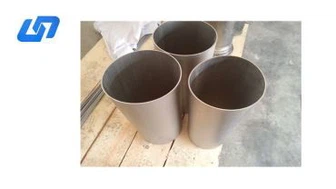
ASTM B861 Titanium Tube
Titanium Tube ASTM B861,titanium pipe
Grades:gr1, gr2, gr3, gr5, gr7, gr9...gr38 titanium and titanium alloy
Process method:cold rolled,hot extruded,dip hole drilling.etc
Product Introduction
ASTM B861 titanium tube is a high-performance titanium tubular product designed for applications requiring excellent corrosion resistance, high strength, lightweight construction, and long-term reliability.
Titanium tubes manufactured according to ASTM B861 are widely used in chemical processing, marine engineering, power generation, aerospace, desalination, and other demanding industrial environments.
Titanium naturally forms a stable and highly adherent oxide film on its surface. This passive oxide layer provides outstanding corrosion resistance in many aggressive media, including seawater, chloride-containing solutions, oxidizing environments, and various acids and alkaline solutions.
Compared with many conventional metallic materials, titanium offers an excellent combination of low density, high specific strength, and superior corrosion resistance.
Product Features
ASTM B861 titanium tubes offer several important advantages:
Excellent corrosion resistance
Outstanding resistance to seawater and chloride-containing environments
High strength-to-weight ratio
Low density
Good mechanical properties
Excellent heat transfer performance
Good fabrication and welding characteristics
Long service life
Suitable for demanding industrial environments
Titanium tubing is particularly suitable for applications where stainless steel or conventional alloys may suffer from corrosion-related degradation.
Material Grades
Titanium tubes can be manufactured from commercially pure titanium and titanium alloys, including:
| Grade | Material Type | Typical Characteristics |
|---|---|---|
| Gr1 | Commercially Pure Titanium | Excellent ductility and corrosion resistance |
| Gr2 | Commercially Pure Titanium | Excellent balance of strength and corrosion resistance |
| Gr3 | Commercially Pure Titanium | Higher strength than Gr1 and Gr2 |
| Gr5 | Ti-6Al-4V | High strength titanium alloy |
| Gr7 | Ti-Pd Alloy | Enhanced corrosion resistance |
| Gr9 | Ti-3Al-2.5V | Medium-strength titanium alloy |
| Gr12 | Ti-Mo-Ni Alloy | Improved corrosion resistance in reducing environments |
Other titanium grades can be supplied according to customer requirements.
Manufacturing Methods
Titanium tubes can be manufactured using different processes depending on the required dimensions, material grade, and application.
Typical manufacturing methods include:
Cold rolling
Hot extrusion
Piercing
Cold drawing
Welding
Seamless tube forming
The manufacturing process is selected to ensure that the finished product meets the mechanical properties, dimensional tolerances, and inspection requirements specified by the applicable standard and customer specifications.
Heat Treatment
Heat treatment conditions are determined according to the titanium grade, manufacturing process, and final application requirements.
For cold-worked titanium tubes, annealing may be performed to restore ductility and relieve residual stress.
Certain titanium alloys may also be supplied in specialized conditions, including:
Annealed
Stress-relieved
Cold-worked and stress-relieved
Solution-treated
Solution-treated and aged
Aged condition
The final delivery condition can be specified according to ASTM requirements or customer technical specifications.
Titanium Tube Bending Test
For applicable grades and sizes, titanium tubes may undergo bending tests to evaluate ductility and material integrity.
Titanium tubes with a nominal diameter of 2 inches (51 mm) and below may be tested by bending the tube through 90° around a cylindrical mandrel.
The bending test evaluates whether the material can withstand deformation without cracking.
The applicable test requirements depend on the titanium grade, dimensions, and relevant ASTM specification.
Titanium Tube Flattening Test
Flattening tests may be performed to evaluate the ductility and structural integrity of titanium tubes.
During the test, a section of the tube is gradually compressed between two parallel plates at room temperature.
The tube is evaluated for cracking or other defects after deformation.
The required flattened height is determined according to factors including:
Nominal outside diameter
Wall thickness
Material grade
Applicable ASTM requirements
For special titanium alloy grades or non-standard dimensions, flattening test requirements can be determined according to the agreement between the manufacturer and purchaser.
Product Specifications
| Parameter | Specification |
|---|---|
| Product | Titanium Tube |
| Standard | ASTM B861 |
| Material | Gr1, Gr2, Gr3, Gr5, Gr7, Gr9, Gr12 and other grades |
| Type | Seamless / Welded |
| Manufacturing | Cold Rolled / Cold Drawn / Hot Extruded / Welded |
| Outside Diameter | Customized |
| Wall Thickness | Customized |
| Length | Random Length / Fixed Length |
| Supply Condition | Annealed / Stress Relieved / Customized |
| Surface | Pickled / Polished / Bright / Machined |
| Inspection | UT / Eddy Current / Hydrostatic Test / Dimensional Inspection |
Custom sizes and technical requirements are available according to customer drawings and project specifications.
Quality Control
Titanium tubes are inspected throughout the production process to ensure material quality, dimensional accuracy, and structural integrity.
Available inspection methods include:
Chemical composition analysis
Mechanical property testing
Dimensional inspection
Ultrasonic testing
Eddy current testing
Hydrostatic testing
Bending testing
Flattening testing
Visual inspection
Additional testing can be arranged according to customer requirements.
Material Test Certificates can be supplied upon request.
Packaging
Titanium tubes are carefully packed to prevent damage during transportation.
Standard packaging options include:
Export plywood cases
Wooden cases
Bundled packaging
Protective wrapping
Customized packaging is available according to customer requirements.
Applications
Heat Exchangers
Titanium tubes are widely used in heat transfer equipment due to their excellent corrosion resistance and long service life.
Typical equipment includes:
Shell-and-tube heat exchangers
Coil heat exchangers
Condensers
Evaporators
Serpentine heat exchangers
Titanium tubing is particularly suitable for seawater cooling and corrosive process media.
Chemical Processing
Titanium tubes are widely used in chemical processing systems handling corrosive fluids.
Typical applications include:
Acid processing
Chloride-containing solutions
Chemical reactors
Process piping
Corrosive fluid transportation
Titanium's stable oxide film provides excellent protection in many aggressive chemical environments.
Marine and Offshore Engineering
Titanium offers excellent resistance to seawater corrosion.
Titanium tubes are commonly used in:
Seawater cooling systems
Marine piping
Offshore platforms
Shipbuilding equipment
Desalination systems
Power Generation
Titanium tubing is widely used in power generation equipment where corrosion resistance and reliability are critical.
Applications include:
Power plant condensers
Heat exchangers
Cooling systems
Nuclear power equipment
Seawater cooling systems
Aerospace Industry
Titanium alloys combine low density with high mechanical strength.
Titanium tubes can be used in aerospace applications such as:
Hydraulic systems
Fuel lines
Structural components
Aircraft systems
The specific titanium grade is selected according to mechanical performance and service environment requirements.
Medical Applications
Certain titanium grades offer excellent biocompatibility and corrosion resistance.
Titanium tubing can be used in specialized medical and biomedical applications, subject to the applicable material standards and regulatory requirements.
Hot Tags:
You Might Also Like


Send Inquiry
