


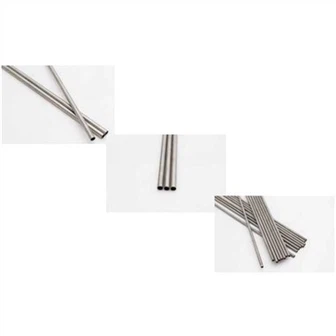
Titanium Copper Composite Tube
Clad material:Ti, ASTM Gr.1 or Gr.2
Core material:Cu, ASTM C11000 and ASTM C10200
Electric conductivity:Cu-HCP ≥99 % IACS 58 MS/m
Application:aerospace components, and marine applications.
Product Introduction
High-Conductivity, Corrosion-Resistant Bimetallic Tubing
Titanium-copper composite tubes combine an inner copper layer with an outer titanium layer, forming a high-performance bimetallic structure. This design integrates the excellent thermal and electrical conductivity of copper with the superior strength and corrosion resistance of titanium.
The result is a durable and efficient material solution for applications requiring both heat transfer performance and resistance to aggressive environments.
Manufacturing Process
Titanium and copper are bonded using advanced techniques such as:
Explosive welding
Roll bonding
This creates a metallurgical bond with a wave-shaped interface, ensuring strong adhesion and stable performance. The bonded material is then processed into tubes using standard forming methods and tested for mechanical and thermal properties.
Specifications
Titanium Grade: Gr1 / Gr2
Copper Grades: C1201, C1100, C1020, C1011, C1220, T1, T2, TU0, TP1, TP2
Shapes Available: Round, drum-shaped, square, flat
Typical Dimensions:
Drum-shaped: φ25–34 × 14 mm
Square: 20–40 mm (rounded corners R3–8°)
Flat: Length 30–100 mm × Width 10–30 mm (R3–5°)
Standards:
GB/T2059, GB/T2067, GB/T2069, GB/T11089, JIS H3100
Performance Characteristics
Bonding strength: ≥125 MPa
Interface shear strength: ≥250 MPa
High bonding integrity (≥99.8%) verified by ultrasonic testing
Stable composite interface with minimal separation
Applications
Heat Exchangers
Ideal for systems requiring efficient heat transfer and corrosion resistance, such as condensers and cooling systems.
Marine & Offshore
Widely used in shipbuilding, seawater systems, and offshore platforms due to excellent resistance to seawater corrosion.
Chemical Processing
Applied in reactors, heat exchangers, and piping systems handling aggressive chemicals.
Aerospace & Engineering
Used in components requiring lightweight strength and thermal performance.
Power & Energy
Suitable for power plants and energy systems where durability and conductivity are critical.
Hot Tags:
You Might Also Like




Send Inquiry
