

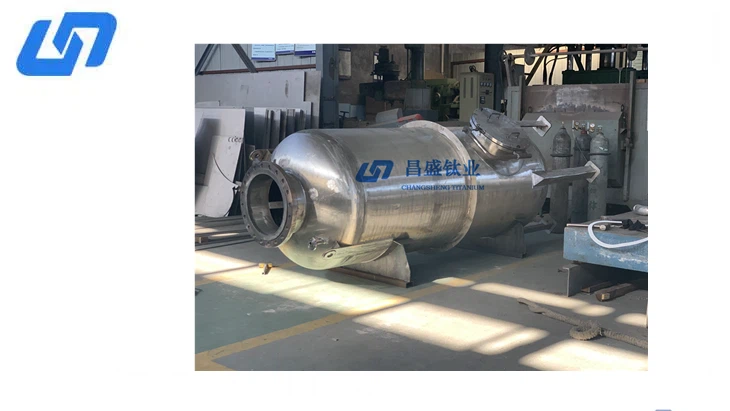
Effect Ⅱ Nickel Evaporator Cyclonic Separator
Type: Effect Ⅱ Evaporator Cyclonic Separator
.
Materials: Nickel 201
.
Specification:DN1200x4 & H=2500
.
Application: Chlor Alkali plant
.
VOLUME (m3):3.3m3
Product Introduction
The Effect II Nickel Evaporator with Cyclonic Separator is a key unit in chlor-alkali plants, designed to concentrate brine (NaOH solution) prior to electrolysis for the production of chlorine and caustic soda.
Operating under vacuum conditions and using steam as the heating source, the system efficiently removes water from the brine. The integrated cyclonic separator minimizes scaling and fouling by continuously removing suspended solids and impurities, ensuring stable long-term operation.
Working Principle
Vacuum Evaporation:
Brine solution is heated by steam under reduced pressure, lowering the boiling point and improving energy efficiency.
Concentration Process:
Water is evaporated, increasing NaOH concentration from approximately 32% to 50%.
Cyclonic Separation:
A vortex flow is generated inside the separator
Centrifugal force drives solids outward
Impurities collect in the sedimentation zone
Clean, concentrated brine exits from the center
This ensures high-purity feedstock for downstream electrolytic cells.
Key Features
High Evaporation Efficiency
Optimized for multi-effect evaporation systems
Integrated Cyclonic Separator
Reduces fouling, scaling, and maintenance
Vacuum Operation (-0.04 MPa)
Enhances thermal efficiency and reduces energy consumption
Nickel 201 Construction
Excellent resistance to strong alkali (NaOH) corrosion
Stable Continuous Operation
Suitable for large-scale chlor-alkali production
Low Maintenance Costs
Extended equipment lifespan
Technical Specifications
Parameter | Value |
Operating Pressure | -0.04 MPa |
Operating Temperature | 135°C |
Medium | NaOH (32% – 50%) |
Material | Nickel 201 |
Volume | 3.3 m³ |
Weight | ~635 kg |
Equipment Structure
Main Components
Evaporator Shell
Size: DN1200 × 4 mm
Cyclonic Separator
High-efficiency solid-liquid separation
Heating System
Steam heating (external)
Sedimentation Chamber
Collects separated impurities
Height: 2500 mm
Material: Nickel 201
Prevents scaling on heat transfer surfaces
Advantages of Cyclonic Separation
Continuous removal of suspended solids
Reduced scaling and fouling
Improved heat transfer efficiency
Lower cleaning frequency
Increased operational reliability
Applications
Chlor-Alkali Industry
Brine concentration systems
Caustic soda (NaOH) production
Chlorine generation processes
Chemical Industry
Alkaline solution concentration
Impurity removal in process streams
Important Technical Note
The nickel evaporator does not function as a membrane device.
Separation of water vapor and salts occurs through thermal evaporation, not membrane electrolysis. The system is designed for phase change (liquid → vapor), while dissolved salts remain in the liquid phase.
Why Choose Nickel 201?
Outstanding resistance to caustic alkali (NaOH)
Stable performance at elevated temperatures
Excellent corrosion resistance in chlor-alkali environments
Long service life with minimal degradation
Hot Tags:
You Might Also Like



Send Inquiry
