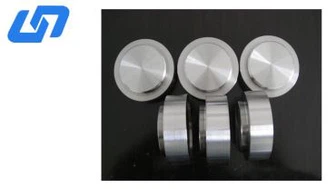
Research On Rolling Forming Of Titanium Alloy Bar
1 Characteristics of rolling forming of titanium alloy bars
The process of rolling titanium alloy bar material is mainly through cooling the larger forged bar billets after rolling, and the cooled bar material mainly takes the form of needles, thin flakes or coarse flakes. After rolling and cooling, the titanium alloy billet can have strong toughness and tensile properties, but at this time, the titanium alloy bar does not have the characteristics of high strength and high plasticity. Generally, industrial production requires the processing of titanium alloy bars to form an equiaxed structure with strong tensile and fatigue properties. However, in the actual rolling process, because the billet is cooled at room temperature, the comprehensive properties of the flaky structure are restricted, and only through targeted deformation treatment can it be axed, which is suitable for market demand. Therefore, the microstructure axialization of titanium alloy bar billets during rolling is an important issue. If the amount of rolling deformation is large, it is easier to improve the structural variability and mechanical properties. When the amount of deformation is small, it will affect the plasticity and strength of the titanium alloy. At the same time, during the rolling process of titanium alloy rods, multiple annealing is performed. In this case, the surface temperature of the rolled product is rapidly reduced, and the internal temperature is increased without decreasing, so that the surface of the rolled product and the center temperature form a larger Poor, and then easy to cause surface cracks. Therefore, the rolling temperature must be properly controlled. Between passes, it becomes a rolling space that controls temperature and continues to deform. Only by recrystallizing a large number of titanium alloy billet can the comprehensive properties of titanium alloy rods be effectively improved.

2 Development Trend and Technology Progress of Titanium Alloys at Home and Abroad
2.1 Development Trend of Titanium Alloys at Home and Abroad
The first titanium alloy that first entered the market and was widely used was the Ti-6AI-4V alloy developed by the United States. The strength, toughness, plasticity, heat resistance, corrosion resistance and compatibility of this titanium alloy are all good, so it has been widely used in the market. With the increasing application requirements of the titanium alloy market, structural titanium alloys are also developing in related directions such as high strength, high plasticity, high toughness and high modulus. Therefore, the current research on titanium alloys at home and abroad mainly includes high-temperature titanium alloys, titanium alloys based on titanium-aluminum compounds, β-titanium alloys with high strength and toughness, flame-retardant titanium alloys, and medical and marine titanium alloys.
(1) High temperature titanium alloys are now mostly used in engines for military and civil aircraft. In recent years, the United States has successfully developed a high-purity and high-performance titanium alloy using rapid solidification powder metallurgy technology, it fully adapt to the difference between the surface and center temperature of the rolled product and ensure the comprehensive application performance of the titanium alloy.
(2) The main advantages of titanium alloys based on titanium-aluminum compounds are better high-temperature performance, and higher resistance to oxidation and creep. At the same time, this titanium alloy has low density and light weight, and can be widely used in aerospace equipment. Russia has successfully researched a new type of aviation titanium alloy. Compared with the traditional titanium alloys, this new type of titanium alloy is lighter in weight and stronger in toughness. It can not only ensure the performance of aerospace vehicles, but also minimize the mass. Reduce resistance.
(3) β titanium alloy is a relatively suitable aviation structural material. In practical applications, it can be matched according to different strength and plasticity requirements, so as to enhance plasticity, practicability and economy to the greatest extent.
(4) For marine titanium alloys, increase the resistance to crevice corrosion, in order to achieve the production and development of durability and high strength requirements. Foreign countries have innovated according to the application needs of various countries. China has also developed several titanium alloys with different strength levels with Chinese characteristics. These titanium alloys are all close to the a-type marine corrosion-resistant titanium alloys, such as TA2, TA5, Ti31, TiB19, Ti70, Ti631.etc. In practical applications, it can be used in combination according to different use conditions. For medical titanium alloys, in order to eliminate the adverse effects of AIv elements as far as possible, a series of new biological titanium alloys have been developed. These titanium alloys generally have good corrosion resistance, wear resistance and fracture resistance. China has also been committed to the research of medical titanium alloys. Under the influence of China's rich titanium resources and research experience, China's research in comprehensive mechanical properties and process performance is superior to foreign medical titanium alloys.
The main marine titanium alloys details are as follows:
The position which use titanium | The common Ti and Ti alloys |
Pressure housing shell | ⅡT-1M, ⅡT-7M, Ti-5Al-2.5Sn, Ti-6Al-4V, Ti-6Al-4VELI Ti-6Al-2Nb-1Ta-0.8Mo, |
Sea pipeline, valve, pump | TA1, TA2, Ti-6Al-4V,Ti-Al-Mn, Ti-6Al-6V-0.5Cu-0.5Fe,Ti-3Al-2.5V, Ti-Ni shape memory, Ti31, Ti75 |
Propeller and propeller shaft | TA1, TA2, Ti-6Al-4V |
Sonar dome insertion | TA1, TA2 |
Heat exchange equipment and desalination device | TA1, TA2,Ti-6Al-4V, Ti-Al-Mn, Ti-5Al, Ti-0.3Mo-0.8Ni Ti31 |
Mooring device and launching device | Ti-6Al-4V, Ti4Al-0.005B, β-C |
Engine parts | Ti-6Al-4V, Ti-5Al-2.5Sn, Ti-8Al-1Mo-1V, Ti-6Al-2Sn-4Zr-2Mo |
2.2 Technical progress of titanium alloys
Titanium alloy rod rolling technology in China mainly includes melting technology, casting technology, isothermal forging technology, heat treatment technology, welding technology, processing technology, surface treatment technology and latest processing technology, etc. Among them, China has achieved good development in smelting technology, and research on induction condensing smelting technology has been added to key research projects. Precision casting technology is mostly used for castings that are difficult to process, which maximizes the utilization of titanium alloy materials and reduces production costs. The rolling technology of other titanium alloys is also controlled as much as possible under the influence of market demand and economic benefits. Based on the experience of research and innovation, it combines theory with practice to carry out in-depth technical reforms and innovations to quickly meet the needs of market development and improve economic efficiency.
3 Development Suggestions for Promoting Roll Forming of Titanium Alloy Bars
The research on the rolling forming technology and method of titanium alloy rods in China should strengthen the depth and dimension. Effectively control the processing technology and cost preparation process, in order to achieve the development of low-cost, high-performance enterprises. Secondly, for the preparation of large-scale high-quality titanium alloy blanks, new preparation technologies should be applied, such as new electron beam and plasma cold-bed furnace melting technologies. For efficient short-flow processing technology, appropriate preparation technologies should be accurately selected to increase the utilization rate of materials, reduce industrial costs, and improve overall economic benefits. At the same time, roll forming also includes laser forming, precision casting, precision forging, spray forming and diffusion linking. China has abundant titanium resources. With the maturation of titanium alloy processing technology in our country, we should actively expand the application range of titanium alloys, promote the internationalization of our titanium alloy applications, improve market competitiveness, and promote titanium Market development.
4 Conclusion
China has abundant titanium resources. On the basis of domestic and foreign research, it has strengthened related research and development of titanium alloy processing and forming technologies. By selecting a reasonable rolling method and process, a comprehensive titanium alloy bar with high strength, high toughness and high plasticity is produced to improve the utilization of the billet. And according to market demand, we can develop diversified, innovative and highly applicable rolling processes to facilitate the application in many fields in actual production. Therefore, China should further strengthen the research and development of rolling technology and methods of titanium alloy rods to promote the reform and innovation of the titanium market as a whole.