


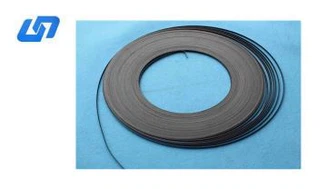
Titanium anode for electrophoretic coating
Type: Electrocoating of car bodies
Material:gr1 titanium plate
Regular size:2x350xLMM,2X360XLMM,2X400XLMM
Material Coating: Iridium Oxide
Coating content: about 12g/m2
Coating area: Single-sided coating
Product Introduction
Titanium anodes are widely used in electrophoretic coating (E-coating) processes, especially in automotive cathodic electrocoating (CED) systems. They play a critical role in maintaining bath stability, coating quality, and process efficiency.
With excellent corrosion resistance, low electrical resistance, and long service life, titanium anodes are the preferred upgrade over traditional stainless steel electrodes.
Working Principle in Electrophoretic Coating
In cathodic electrophoresis:
The workpiece (e.g., car body) acts as the cathode
Positively charged paint particles (resin + pigment) migrate and deposit on the surface
At the cathode, water electrolysis produces OH⁻ ions, enabling coating formation
At the anode:
Organic acids are continuously generated
If not removed, they:
Lower bath pH
Affect coating stability
Reduce coating quality and penetration
Therefore, a stable and efficient anode system is essential for process control.
Typical Technical Parameters
Parameter | Value |
Application | Automotive body electrocoating |
Substrate Material | Gr1 titanium plate |
Coating Type | Iridium oxide (IrO₂) |
Coating Weight | ~12 g/m² |
Coating Area | Single-sided |
Operating Temperature | ≤ 32°C |
Current Density | ≤ 80 A/m² |
Service Life | > 2 years |
Standard Sizes | 2×350×L mm / 2×360×L mm / 2×400×L mm |
Quantity (Typical Line) | 140 – 160 pcs |
Anode System Composition
A complete anode system includes:
Anode electrode (titanium MMO coated)
Anode diaphragm (ion exchange membrane)
Anolyte circulation system
Pump
Pipeline
Anolyte tank
Monitoring system
Conductivity controller
Turbidity control
Deionized water supply system
Tubular Anode System (Modern Standard)
Compared with traditional plate anodes, tubular anodes offer:
Compact structure
Lower membrane resistance
Reduced power consumption
Higher coating throwing power
Larger effective membrane area
Longer service life
Easier maintenance and installation
Can be installed side / bottom / top of coating tank for flexible design.
Advantages of Titanium Anodes
1. Superior Corrosion Resistance
Resistant to acidic environments and chlorine-containing media
Not affected by chloride ions (unlike stainless steel)
2. Long Service Life
Several times longer than stainless steel anodes
Stable performance over long production cycles
3. Stable Electrochemical Performance
Dimensionally stable anode (DSA)
Minimal coating loss during operation
Consistent voltage and current efficiency
4. Reusable Substrate
Only coating needs reapplication after deactivation
Titanium base remains intact → reduces long-term cost
5. Improved Process Stability
Avoids passivation instability of stainless steel
Reduces maintenance frequency
Ensures continuous, stable production
Comparison: Titanium vs Stainless Steel Anodes
Feature | Titanium MMO Anode | Stainless Steel Anode |
Corrosion Resistance | Excellent | Limited |
Chloride Resistance | Excellent | Poor |
Service Life | Long | Short |
Stability | High | Affected by passivation |
Maintenance | Low | Frequent replacement |
Applications
Automotive body electrophoretic coating (CED lines)
Industrial electrocoating systems
Metal surface finishing processes
Large-scale coating production lines
Summary
Titanium anodes for electrophoretic coating provide long-lasting, stable, and high-efficiency performance, significantly improving coating quality, production stability, and operational cost control.
They are the preferred solution for modern automotive and industrial electrocoating systems, especially in large-scale continuous production environments.
Hot Tags:
You Might Also Like




Send Inquiry
