

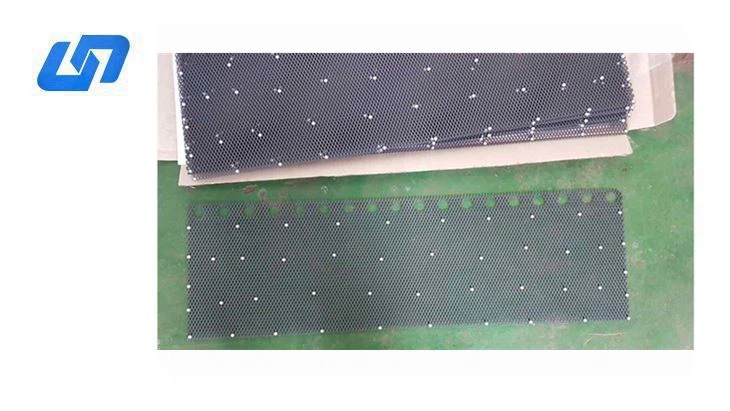
Titanium Anode Electrode for Power Plant
Titanium Electrode for Circulating water treatment;
Titanium electrode for power plant;
Grating: 1.2 × 911 × 278mm
Plate Type: 1.2 × 911 × 278mm
Coating Type: Ru/Ir titanium coating
Product Introduction
Product Overview
Ru/Ir (Ruthenium/Iridium) coated titanium anodes are high-performance mixed metal oxide (MMO) electrodes widely used in electrochemical water treatment systems.
The Ru/Ir catalytic coating applied on a titanium substrate provides:
Excellent corrosion resistance
High chlorine evolution efficiency
Long-term dimensional stability
Strong adhesion and durability
Stable performance in harsh environments (seawater & brine)
These properties make Ru/Ir titanium anodes the preferred solution for power plant circulating cooling water treatment systems worldwide.
Coating Technology
The Ru/Ir coating is typically applied through thermal decomposition:
Titanium substrate pretreatment (sandblasting / acid washing)
Application of Ru & Ir salt solution
High-temperature thermal decomposition
Formation of a dense, uniform MMO catalytic layer
The resulting coating:
Thickness: several microns
Surface: smooth and uniform
Strong metallurgical bonding
Long service life
Application in Power Plants
1. Circulating Cooling Water Treatment
In thermal power plants, cooling water systems often use:
Seawater (coastal plants)
Freshwater systems
Marine organisms, algae, and bacteria can cause:
Biofouling
Reduced cooling efficiency
Blockage
Biological corrosion
Ru/Ir titanium anodes are used in electrochlorination systems to generate sodium hypochlorite on-site from seawater or diluted brine. The produced chlorine:
Kills larvae and marine organisms
Prevents algae growth
Reduces scaling
Protects heat exchange systems
This eliminates the need for chlorine gas transportation and improves operational safety.
2. Electrochemical Oxidation of Wastewater
Power plants generate wastewater containing organic and inorganic pollutants.
Ru/Ir coated titanium anodes are widely used in:
Electrochemical oxidation systems
Advanced oxidation processes
Industrial wastewater treatment
Typical Specifications
Common Types
Grating Type
Dimension: 1.2 × 911 × 278 mm (D × L × W)
Activation Area: 0.212 m²
Plate Type
Dimension: 1.2 × 911 × 278 mm (D × L × W)
Activation Area: 0.212 m²
Chemical Composition (Titanium Substrate – Gr1/Gr2)
| Element | Max wt% |
|---|---|
| H | 0.013 |
| O | 0.20 |
| N | 0.03 |
| Fe | 0.25 |
| Ti | Balance |
Mechanical Properties
| Item | Standard Value |
|---|---|
| Tensile Strength | 340–510 N/mm² |
| Yield Strength | ≥ 215 N/mm² |
| Elongation | ≥ 23% |
| Bend Test | 180° |
Working Conditions
Electrolyte: Seawater / Brine
Main Reaction: Chlorine evolution
Temperature: < 60–80°C
High corrosion environment resistant
Note:
Excessive impurities in water may cause surface scaling. Proper filtration and maintenance extend electrode life.
Key Advantages
High chlorine evolution efficiency
Long service life
Strong anti-corrosion performance
Dimensionally stable anode
Safe on-site chlorine generation
Reduced operating cost
Suitable for high salinity environments
Typical Applications in Power Plants
Electrochlorination systems
Seawater antifouling systems
Cooling water sterilization
Algae removal
Industrial wastewater electro-oxidation
Hot Tags:
You Might Also Like



Send Inquiry
