


Chlorine Evolution Titanium Anodes
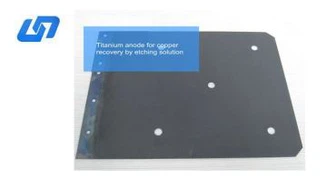
Ru-Ir titanium anode, titanium anode for chlorine evolution
Substrate material: Gr1 titanium plate/ mesh/ tube/ rod
Coated precious metal: Ruthenium/ Iridium oxide
Dimension as customized
Product Introduction
Chlorine evolution titanium anode refers to ruthenium-iridium oxide mixed coated titanium anode. The substrate of ruthenium-iridium oxide titanium anodes is based on titanium plates, titanium meshes, and titanium tubes, coated with precious metal oxides such as Ruthenium. They have a strong potential for chlorine evolution. Due to considerable electrocatalytic activity in the chlorine evolution reaction (CER), ruthenium oxide-based electroactive coatings on titanium substrate are used as anodes for the industrial production of chlorine and chlorates and are widely used in disinfection and sterilization, machine, hydrogen-rich water cup, cathodic protection, circulating water descaling, and electrochemical synthesis industry.
Features:
1. High anti-corrosion performance, good reverse performance.
2. High current efficiency and extremely low energy consumption compared to graphite anodes.
3. Long working life, in the Chlor-alkali industry, the service life is more than 8 years.
4. After the electrode is deactivated, the substrate can be reused.
Chlor-alkali industry test data:
1. Chlorine evolution potential: ≤1.13v
2. Chlorine evolution polarizability: ≤40mv
3. Enhanced life: ≥3000min, current density 10000A / m2
Product Specification
Technique | sanding blasting, acid washing, brush coating |
Ti Content (%) | Titanium purity over 99.6% |
Processing Service | Bending, Welding, Decoiling, Cutting, Punching |
Material | Gr1 titanium as substrate |
Type | Mesh, sheet/plate, rod/wire, pipe/tube |
Finishing | Pickling, machining, abrasive blasting |
Dimension | Custom-made sizes available |
Process
1. Use Gr1 titanium as substrate, make sure the surface of the board is smooth and smooth, without deep scratches and incompleteness.
2. Machining the selected titanium substrate to the specifications required by customers.
3. Anneal and level the titanium substrate at a temperature of> 500 ° C. (To eliminate stress and ensure flatness.)
4. During the annealing and leveling process, a dense titanium oxide layer will be formed on the surface of the titanium substrate, and it will be polished mechanically or manually to make the surface of the titanium metallic luster.
5. The titanium substrate is pickled and etched with 10% oxalic acid, and the surface is etched to a titanium hydride surface for several hours in a slightly boiling state.
6. Make reasonable qualitative and quantitative configurations of the precious metal solution according to the anode environment applied by the customer.
7. The acid-washed titanium substrate is qualified, that is, the surface layer is a gray and uniform matte structure, and then the artificial coating is performed, and sintering is performed at a proper temperature. After the sintering, natural cooling is performed, and the second coating is performed when cooling to normal temperature, And so on, and so on, until 17 to 20 times to finish the coating solution.
8. After the above-processed parts are sintered, the life test is carried out with the test piece of the furnace, and the packages are tested and shipped.
Application
Chlorine evolution titanium anodes are widely used in various industries for electrochemical processes that involve the production of chlorine gas. Here are some applications below:
Chlor-alkali industry: Ruthenium-coated titanium anodes are used in the chloralkali industry to produce chlorine gas and caustic soda through the electrolysis of brine solution. The anodes are used in electrolytic cells where they facilitate the separation of chlorine gas from the brine solution.
Water treatment: ruthenium-iridium oxide mixed-coated titanium anodes are used in the treatment of water to remove impurities and kill bacteria. They are used in electrochemical disinfection processes where they generate chlorine gas that reacts with water to form hypochlorous acid, which is an effective disinfectant.
It find wide applications in various industries for electrochemical processes that involve the production of chlorine gas. They are used in the chlor-alkali industry, and water treatment mainly. These titanium anodes offer high efficiency, durability, and safety, making them the preferred choice of anode material in many industries. Being professional titanium anode factories, we have more than 20 years of experiences on the water treatment field.
Hot Tags:
You Might Also Like



Send Inquiry
