


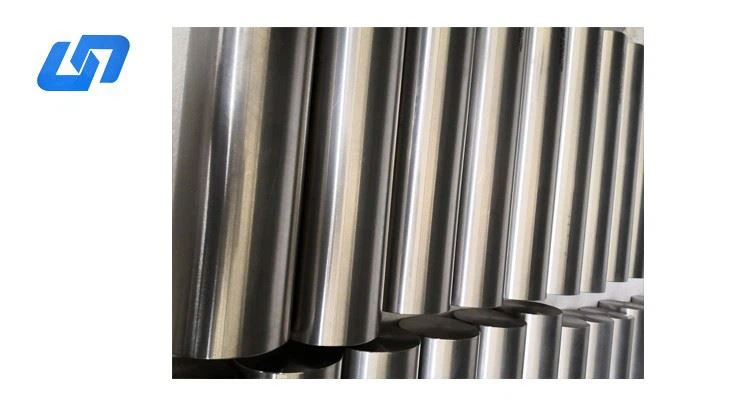
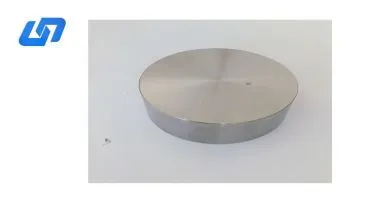
Titanium Alloy Bar
OT4-1/Ti-2Al-1.5Mn Titanium alloy rods
size:dia.89mm
tensile strength:540Mpa
specific elongation at fracture:10%
reduction of area:26%
Product Introduction
Product Standards & Overview
Titanium and titanium alloy bars and billets are typically supplied in annealed condition according to:
ASTM International - ASTM B348
ASME SB-348
The standard covers a wide range of titanium grades including:
1–4H, 5, 6, 7H, 9, 11, 12, 13–21
23–38 and other specialty grades.
Materials must meet:
Table 1 - Chemical composition requirements
Table 2 - Tensile mechanical property requirements
Product Definitions
Titanium Alloy Bar
A semi-finished solid product manufactured by:
Cold working
Hot rolling
Forging
Extrusion
Dimensional Requirements
Cross-sectional area ≤ 16 in² (10323 mm²)
Rectangular bar width ≤ 10 in (254 mm)
Thickness ≤ 0.1875 in (4.8 mm)
Note: Extruded bars are mainly used for Grades 1–4 commercially pure titanium unless otherwise specified.
Titanium Billet
A semi-finished product manufactured by hot working or forging ingots.
Characteristics:
Width < 5 × thickness
Cross-sectional area > 16 in² (10323 mm²)
Alloy Type - Ti2Al1.5Mn
Ti-2Al-1.5Mn is a high-strength α+β titanium alloy composed of:
Titanium (Ti)
Aluminum (Al)
Manganese (Mn)
Typical composition:
| Element | Content (wt%) |
|---|---|
| Fe | ≤ 0.3 |
| C | ≤ 0.1 |
| Si | ≤ 0.12 |
| Mn | 0.7 – 2.0 |
| N | ≤ 0.05 |
| Ti | 94.33 – 97.5 |
| Al | 1.5 – 2.5 |
| Zr | ≤ 0.3 |
| O | ≤ 0.15 |
| H | ≤ 0.012 |
| Impurities | ≤ 0.3 |
Microstructure Characteristics
Titanium alloy bars typically contain α + β dual-phase microstructures:
α Phase
Provides high strength
Provides toughness and fatigue resistance
β Phase
Improves ductility
Enhances formability and machinability
This balance makes titanium alloys ideal for high-performance engineering applications.
Physical Properties
| Temperature (°C) | Young's Modulus (GPa) | Thermal Expansion Coefficient | Thermal Conductivity W/(m·K) | Density kg/m³ | Specific Heat J/(kg·K) |
|---|---|---|---|---|---|
| 20 | 1.1 | 9.63 | - | 4550 | 1010 |
| 100 | - | 8 | 10.47 | - | - |
| 200 | - | 8 | 11.3 | - | - |
| 300 | 9.1 | 12.14 | 0.565 | - | - |
| 400 | 9.6 | 14.24 | 0.628 | - | - |
| 500 | 9.7 | 14.65 | 0.754 | - | - |
| 600 | 9.8 | 16.32 | - | - | - |
Weldability
Titanium alloys exhibit good weldability depending on alloy composition.
| Condition | Welding Characteristics |
|---|---|
| Without limitations | Welding can be performed without preheating or post-heat treatment |
| Limited weldability | Preheating to 100–120°C may be required |
| Difficult weldability | Preheating to 200–300°C plus annealing treatment recommended |
Key Advantages of Titanium Alloy Bars
High strength-to-weight ratio
Excellent corrosion resistance
Good fatigue resistance
Stable performance in seawater environments
Suitable for extreme temperature environments
Applications
Aerospace Industry
Titanium alloy bars are widely used in aircraft structural components.
Example:
Landing gear components for aircraft such as the Boeing Company 777 aircraft.
Landing gear parts include:
Main strut
Side strut
Drag strut
Benefits:
Reduces structural weight
Maintains high impact strength during takeoff and landing
Marine & Offshore
Amphibious aircraft components
Offshore platform equipment
Titanium's seawater corrosion resistance makes it highly suitable for marine environments.
Automotive & Industrial
High-performance engine components
High-strength fasteners
Precision structural parts
Summary
Ti2Al1.5Mn and Ti-6Al-4V class titanium alloys provide:
Excellent mechanical strength
High corrosion resistance
Superior fatigue and impact resistance
Wide aerospace, marine, and industrial adaptability
These properties make titanium alloy bars critical materials for high-end engineering applications.
Hot Tags:
You Might Also Like


Send Inquiry
