


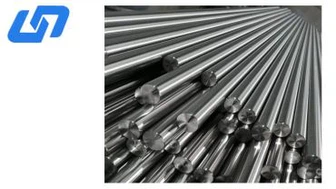
Grade 5 Titanium Rod
Grade 6/Ti-5Al-2.5Sn
Used for Gas turbine engine casings and rings, Aerospace structural parts, aircraft engine and airframe. Chemical processing equipment
Product Introduction
As an α+β type titanium alloy, Grade 5 titanium (Ti-6Al-4V) can be heat treated to achieve higher strength and is commonly supplied in annealed condition for industrial applications.
Due to its outstanding mechanical properties and excellent strength-to-weight ratio, Grade 5 titanium rods are widely used in aerospace, medical implants, marine engineering, chemical processing, automotive, and high-performance industrial applications.
Key Features
High Strength-to-Weight Ratio
Grade 5 titanium provides strength comparable to many steel alloys while being significantly lighter.
Advantages:
Reduced structural weight
Improved energy efficiency
High load-bearing capability
Excellent fatigue resistance
Excellent Corrosion Resistance
Ti-6Al-4V forms a stable oxide film on the surface, providing excellent resistance against:
Seawater corrosion
Chloride environments
Chemical media
Industrial atmospheres
Suitable for long-term operation in harsh environments.
High Temperature Performance
Grade 5 titanium maintains reliable mechanical properties at elevated temperatures.
Typical service capability:
Long-term working temperature: up to approximately 400°C
Short-term applications: higher temperature capability depending on design conditions
Good Welding Performance
Grade 5 titanium rods provide good fusion welding performance when proper shielding methods are applied.
Suitable welding methods include:
Tungsten inert gas (TIG) welding
Metal inert gas (MIG) welding
Technical Specifications
| Parameter | Specification |
|---|---|
| Material Grade | Grade 5 Titanium (Ti-6Al-4V) |
| Alloy Type | α+β Titanium Alloy |
| Standard | ASTM B348 / Equivalent |
| Supply Condition | Annealed / Heat Treated |
| Product Form | Titanium Rod / Bar |
| Diameter | Customized |
| Length | Customized |
| Surface | Machined / Polished / Peeled |
Chemical Composition
| Element | Content (%) |
|---|---|
| Titanium (Ti) | Balance |
| Aluminum (Al) | 4.0 – 6.0 |
| Vanadium (V) | 3.5 – 4.5 |
| Iron (Fe) | ≤0.40 |
| Oxygen (O) | ≤0.20 |
| Carbon (C) | ≤0.08 |
| Nitrogen (N) | ≤0.05 |
| Hydrogen (H) | ≤0.015 |
| Other Elements | According to ASTM requirements |
Physical Properties
| Property | Metric | Imperial |
|---|---|---|
| Density | 4.43 g/cm³ | 0.160 lb/in³ |
| Melting Point | Approx. 1600°C | Approx. 2900°F |
| Elastic Modulus | 110–120 GPa | 16,000–17,400 ksi |
| Thermal Conductivity | Approx. 6.7 W/m·K | - |
Mechanical Properties
Typical annealed condition:
| Property | Value |
|---|---|
| Tensile Strength | ≥895 MPa |
| Yield Strength | ≥825 MPa |
| Elongation | ≥10% |
| Reduction of Area | ≥25% |
Manufacturing Process
Changsheng Titanium Grade 5 rods are produced through strict manufacturing procedures:
1. Raw Material Preparation
High-quality titanium alloy billets are selected according to required standards.
2. Forging & Rolling
The billets are processed through:
Hot forging
Hot rolling
Precision machining
to achieve required dimensions and mechanical properties.
3. Heat Treatment
Heat treatment processes include:
Annealing
Solution treatment
Aging treatment (when required)
to optimize strength and toughness.
4. Surface Treatment
Available finishes:
Machined surface
Centerless grinding
Polishing
Pickling
Applications
Aerospace Industry
Grade 5 titanium rods are widely used for:
Aircraft structural components
Engine parts
Compressor components
Fasteners
Landing system components
Advantages:
Lightweight
High fatigue strength
Excellent temperature performance
Marine & Offshore Engineering
Used in:
Offshore drilling equipment
Marine structures
Seawater systems
Ship components
Excellent resistance to seawater corrosion ensures long service life.
Medical Industry
Due to excellent biocompatibility, Grade 5 titanium is commonly used for:
Bone plates
Screws
Dental implants
Surgical instruments
Chemical Processing Equipment
Applications include:
Reactors
Heat exchangers
Pumps
Valves
Piping systems
Titanium alloy provides reliable performance in corrosive environments.
Automotive Industry
Used in:
High-performance vehicle components
Racing parts
Lightweight structural components
Benefits:
Weight reduction
Improved efficiency
High mechanical strength
Sporting Equipment
Applications:
Bicycle frames
Golf club components
High-performance sports equipment
Architectural Applications
Titanium rods and components are used in:
Building facades
Decorative structures
Roofing systems
because of their:
Unique appearance
Durability
Weather resistance
Advantages Compared With Other Materials
| Property | Titanium Grade 5 | Stainless Steel | Aluminum |
|---|---|---|---|
| Weight | Low | High | Very Low |
| Strength | Excellent | High | Medium |
| Corrosion Resistance | Excellent | Good | Medium |
| Fatigue Resistance | Excellent | Good | Medium |
| Temperature Performance | Excellent | Good | Limited |
Hot Tags:
You Might Also Like



Send Inquiry
